10 Must-Have Shopify Apps for Small Store Owners
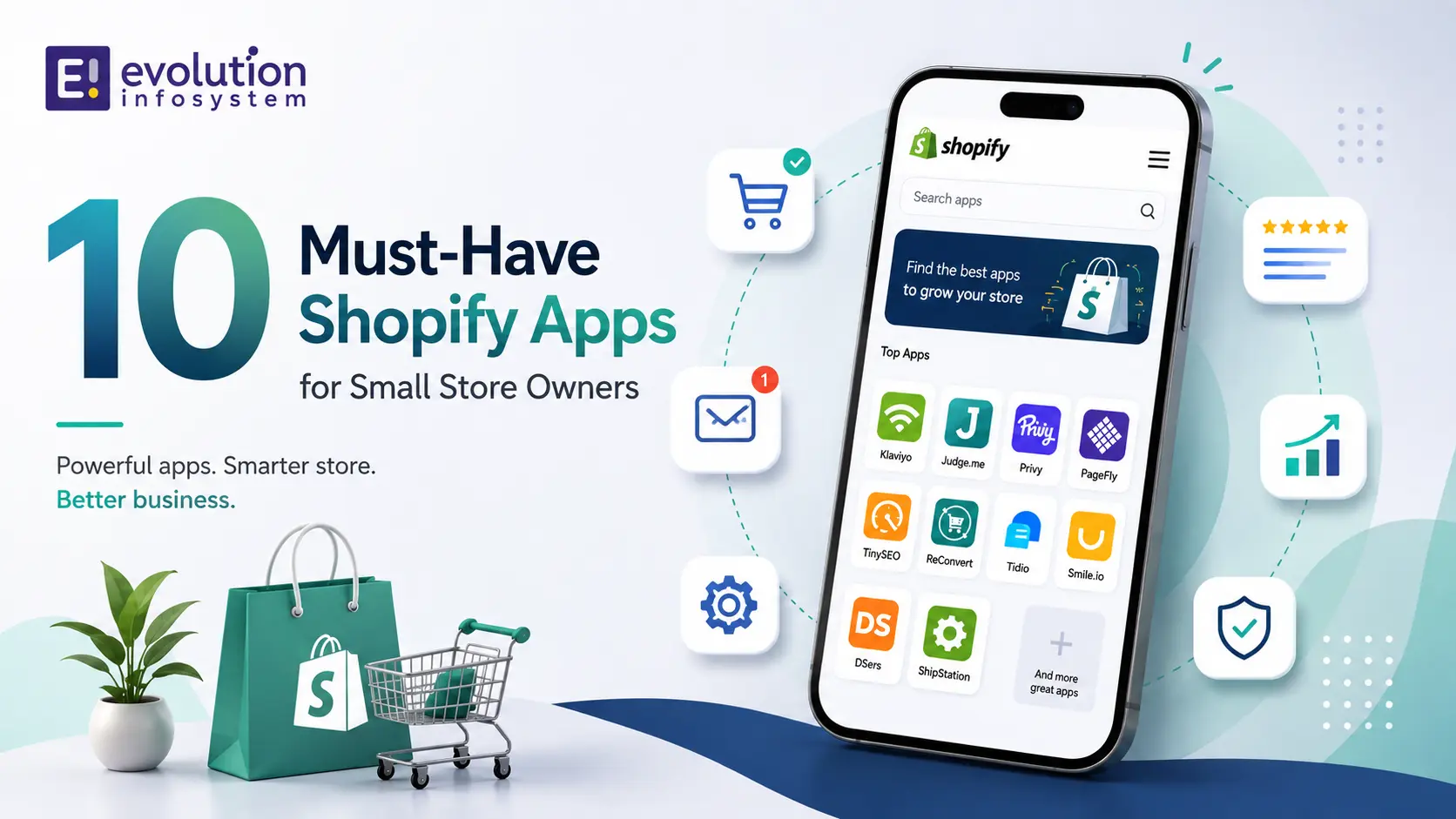
The Shopify App Store has over ten thousand listings, and roughly none of that number tells you which ten actually matter when you are running a small store on a tight budget. This roundup of the best Shopify apps for small stores skips the noise and focuses on what genuinely moves revenue for stores that cannot afford to gamble on a subscription that does not pay for itself.
Most “best Shopify apps” lists are written for stores doing seven figures a month, recommending tools that cost hundreds of dollars before you have proven your product works. This list of the best Shopify apps for small stores is different – every pick here has a free or low-cost entry tier, a clear job to do, and a track record of paying for itself quickly.
We wrote this from an agency perspective. Evolution builds and customizes Shopify stores for small and growing businesses, and this list of the best Shopify apps for small stores reflects what we actually see clients install and keep using, not a sponsored roundup padded with apps nobody sticks with past the free trial. By the end, you should have a concrete, prioritized shortlist rather than ten more browser tabs open comparing features you do not yet need.
Who This Guide Is For
This guide is for store owners who just launched or are still under a few hundred orders a month, marketers managing a lean Shopify stack, and anyone overwhelmed by app store search results and looking for a shortlist they can trust. If you already know which category you need, jump ahead to that specific pick. If you are starting completely from scratch, read through the full prioritized order, since it is designed to be followed roughly in sequence as your store grows.
How We Picked These Apps
Every app on this list of the best Shopify apps for small stores had to meet four criteria: a genuinely useful free tier or low-cost entry plan, strong recent reviews from small merchants specifically (not just enterprise case studies), a clear, single job rather than an overwhelming feature list, and evidence of real revenue or time-saving impact, not just vanity features.
This filtering matters because small stores cannot afford app bloat – every additional subscription eats into thin early-stage margins, and every additional script slows down page load, which hurts conversion. The best Shopify apps for small stores are the ones that earn their spot, not just the ones with the biggest marketing budget. We also weighed how quickly each app can realistically be set up by a solo founder without technical help, since a powerful tool that takes a week to configure properly is a poor fit for someone also handling inventory, customer service, and marketing alone.
Quick Answer: The Short List
If you only have time to read one section, here is the short version of the best Shopify apps for small stores, grouped by what they solve: Klaviyo for email and SMS, Judge.me for reviews, Privy for popups and lead capture, PageFly for landing pages, TinySEO for search optimization, ReConvert for post-purchase upsells, Tidio for live chat, Smile.io for loyalty, DSers for sourcing, and ShipStation for fulfillment.
The rest of this guide explains why each one made the cut and how to prioritize installing them without overwhelming your store or your budget on day one. Even if you only implement three or four of these to start, you will already be ahead of most small stores that either install everything at once or nothing at all.
The 10 Best Shopify Apps for Small Stores
Here are the ten apps, in the order most small stores should consider installing them, starting with the ones that address the most common early-stage revenue leaks first.
1. Klaviyo – Email and SMS Marketing
Klaviyo consistently tops lists of the best Shopify apps for small stores because email remains one of the highest-ROI channels available, and unlike social media followers, your email list is an asset you fully own and control.
Klaviyo syncs directly with your store data to trigger abandoned cart reminders, welcome series, and win-back campaigns automatically. Its free tier covers a meaningful number of contacts before you need to pay, making it one of the most accessible best Shopify apps for small stores just starting to build a list. Its AI-assisted send-time optimization and product recommendation blocks have also improved noticeably, helping even a small list perform closer to what a much larger, more sophisticated marketing team could achieve manually.
2. Judge.me – Reviews and Social Proof
Social proof is one of the strongest conversion levers a small store has, and Judge.me is consistently recommended among the best Shopify apps for small stores specifically because its free plan includes unlimited review requests, something many competitors gate behind a paid tier.
It automatically emails customers post-purchase requesting reviews with photos, displays them attractively on product pages, and integrates with Google Shopping for review-rich search listings, which meaningfully improves click-through rate from search results.
3. Privy – Popups and Lead Capture
Built specifically with small and growing merchants in mind, Privy earns its place among the best Shopify apps for small stores by keeping popups, email capture, and basic automation simple enough that a non-technical store owner can set it up in an afternoon.
Exit-intent popups, spin-to-win discount wheels, and cart abandonment emails all live inside one straightforward dashboard, without the steep learning curve that comes with more enterprise-oriented marketing platforms.
4. PageFly – Drag-and-Drop Page Builder
Small stores rarely have a developer on staff, which is exactly the gap PageFly fills – a visual, drag-and-drop builder for landing pages, product pages, and custom sections without touching a line of code.
It earns its spot among the best Shopify apps for small stores because it works with virtually any Shopify theme and includes a generous free tier, letting store owners build a genuinely custom-looking storefront without a custom development budget. Templates for common page types – sales landing pages, FAQ pages, about pages – cut setup time further, so even a first-time user can publish a polished page within an hour or two.
5. TinySEO – SEO and Site Speed
Organic search remains one of the few acquisition channels that does not require an ongoing ad budget, which is why an SEO app belongs on any serious list of the best Shopify apps for small stores. TinySEO audits your store for common issues – missing meta descriptions, slow page speed, broken alt text – and flags fixes in plain language.
Site speed in particular deserves attention here, since a slower store directly hurts both search ranking and conversion rate, making SEO and performance genuinely inseparable concerns for a small store’s long-term traffic growth.
6. ReConvert – Post-Purchase Upsells
ReConvert turns the order confirmation page – a page most stores waste entirely – into a revenue opportunity, making it one of the more clever entries among the best Shopify apps for small stores focused on increasing average order value without new traffic.
Add related product offers, reorder buttons, and limited-time post-purchase discounts, all with no coding required. Because the customer has already completed checkout, conversion rates on these offers tend to be meaningfully higher than a typical upsell shown earlier in the funnel. A birthday capture form on the same page also quietly builds a data point most stores never bother collecting, useful for future personalized campaigns.
7. Tidio – Live Chat and AI Chatbot
Customer questions that go unanswered for hours often turn into abandoned carts, which is why live chat support consistently ranks among the best Shopify apps for small stores that cannot yet afford a dedicated support team.
Tidio combines live chat with an automated chatbot that handles common questions – shipping times, return policy, order tracking – instantly, escalating to a human only when genuinely needed, which keeps response times fast without requiring someone at a screen around the clock. Its abandoned cart bot can also proactively offer a small discount to a hesitant visitor, recovering sales that would otherwise simply leave.
8. Smile.io – Loyalty and Rewards
Retaining an existing customer costs far less than acquiring a new one, and Smile.io’s points-and-rewards system is one of the more approachable best Shopify apps for small stores looking to build repeat purchase behavior without a complex loyalty program.
Its free plan covers the essentials – points for purchases, referral rewards, and a simple redemption flow – which is often enough for a small store to start seeing measurably higher repeat purchase rates within the first few months. The referral component in particular tends to be underrated, since it turns existing satisfied customers into a low-cost acquisition channel without any additional ad spend.
9. DSers – Sourcing and Dropshipping
For small stores testing product-market fit before committing to inventory, DSers earns its place among the best Shopify apps for small stores by connecting directly to supplier catalogs, automating order fulfillment without holding stock upfront.
This is not the right long-term model for every store, but for validating demand on a new product line with minimal upfront capital risk, it remains one of the lowest-barrier ways to test an idea before investing in inventory.
10. ShipStation – Shipping and Fulfillment
Once a small store starts shipping physical inventory regularly, manually printing labels and calculating rates becomes a real time drain, which is where ShipStation rounds out this list of the best Shopify apps for small stores handling their own fulfillment.
It compares rates across carriers automatically, batch-prints shipping labels, and syncs tracking information back to Shopify and to customers, saving hours of manual work every week once order volume picks up.
Runner-Up Apps Worth Knowing About
A few apps just missed the main list of the best Shopify apps for small stores, either because they serve a narrower use case or overlap heavily with a pick already covered, but are still worth knowing about depending on your specific store.
Omnisend – Email and SMS Alternative to Klaviyo
Omnisend offers a simpler interface than Klaviyo with strong multichannel automation, making it a solid alternative among the best Shopify apps for small stores that want an email-first strategy without Klaviyo’s steeper learning curve.
Loox – Photo Reviews Focused App
Where Judge.me covers general reviews well, Loox specializes specifically in photo and video reviews, which can be worth the upgrade for visually driven categories like fashion, beauty, or home decor.
Gorgias – Helpdesk for Growing Support Volume
Once ticket volume outgrows what Tidio’s live chat handles comfortably, Gorgias offers a fuller helpdesk with order data integrated directly into support tickets, worth considering as support needs mature past the earliest stage. Its pricing starts reasonably for low ticket volumes, making the transition from Tidio to Gorgias a natural upgrade path rather than a jarring cost jump.
Choosing Apps Based on Your Store’s Category
While the ten picks above work well broadly, certain categories benefit from weighting specific apps more heavily within any list of the best Shopify apps for small stores.
Fashion and Apparel
Prioritize photo-review apps and a strong page builder, since visual presentation drives conversion disproportionately in this category compared to most others.
Food and Consumables
Subscription and loyalty apps tend to matter more here than in other categories, since repeat purchase behavior is central to the business model from day one.
Handmade and Made-to-Order Goods
Live chat and clear shipping communication matter disproportionately, since customers buying custom or handmade goods tend to have more questions before and after purchase than typical retail buyers.
Dropshipping and Print-on-Demand
Sourcing apps like DSers become the foundation of the entire operation rather than one tool among several, making that category the natural starting point for this business model specifically.
What These Apps Have in Common
Looking across all ten entries on this list of the best Shopify apps for small stores, a clear pattern emerges: every one solves exactly one problem well, offers a genuinely usable free or low-cost tier, and integrates cleanly with Shopify’s existing checkout and theme structure without heavy custom configuration.
- A free or low-cost entry tier that delivers real value, not just a crippled trial
- A single, clear job rather than an overwhelming, unfocused feature set
- Strong recent reviews specifically from small merchants, not just enterprise case studies
- Minimal setup time, since small store owners rarely have a dedicated developer on staff
- Clean integration with Shopify’s native checkout and theme system
Apps that fail these criteria – expensive from day one, unclear value proposition, complex setup – rarely make it onto a genuinely useful list of the best Shopify apps for small stores, regardless of how well-funded their marketing is.
How Many Apps Is Too Many?
Every app you install adds a script that loads on your storefront, and enough of them compound into real page speed problems that hurt both conversion and SEO. Even the best Shopify apps for small stores can become a liability in excess.
A useful rule of thumb: install only apps solving a problem you actually have right now, not one you anticipate having someday. Review your installed app list quarterly and remove anything you have not actively used or checked in the last month – unused apps quietly slow your store down while providing zero ongoing value.
Data Privacy and App Permissions
Every app you install requests some level of access to your store data – customer information, order history, or product catalog details. Before installing any app, even one appearing on a trusted list of the best Shopify apps for small stores, review exactly what permissions it requests and whether that access is proportional to what the app actually does.
This matters more once your store handles meaningful customer data, since a compromised or poorly secured third-party app becomes a potential data exposure point outside your direct control. Stick to well-reviewed, actively maintained apps with a track record, and remove access for any app you stop actively using rather than leaving old permissions in place indefinitely. This same discipline applies whether an app made it onto this list of the best Shopify apps for small stores or was picked up independently – permission hygiene is a habit worth building regardless of which specific tools you run.
Cost Considerations for a Small Store Budget
Most of the best Shopify apps for small stores on this list offer a genuinely usable free tier, which matters enormously for a store still validating its product. Total combined cost, even running several of these apps on paid tiers as you grow, typically stays well under a hundred dollars a month for a small store’s early stage.
As order volume grows, expect several of these apps to require upgrading to paid tiers based on contact count, order volume, or ticket count. Budget for this growth rather than being surprised by it – it is a sign the app is actually being used enough to matter, not a red flag in itself.
Why Not Just Use Shopify’s Built-In Features?
Shopify’s native platform covers the basics reasonably well: a simple email tool, basic discount codes, and standard checkout. So why do the best Shopify apps for small stores matter if the core platform already includes some of this functionality?
The honest answer is depth. Shopify’s native email tool lacks the sophisticated automation and segmentation Klaviyo offers. Built-in discount codes cannot replicate a spin-to-win popup or an exit-intent offer the way Privy can. For a small store competing against others using specialized tools, relying solely on native features often means leaving meaningful conversion and retention gains on the table.
That said, do not install an app to replace a native feature that already meets your needs. If Shopify’s built-in discount codes work fine for your current promotions, there is no reason to add a dedicated app just because it appears on a list of the best Shopify apps for small stores – match the tool to an actual gap, not a theoretical one.
A Prioritized Installation Order
Do not install all ten simultaneously. Here is a practical sequence for rolling out the best Shopify apps for small stores without overwhelming yourself or your storefront speed on day one.
- Start with Judge.me and Klaviyo – social proof and email capture matter from your very first sale
- Add Privy once you have meaningful traffic to convert into an email list
- Add PageFly and TinySEO when you are ready to invest in landing pages and organic traffic
- Add ReConvert and Tidio once you have steady order volume to optimize and support
- Add Smile.io once you have enough repeat customers for a loyalty program to make sense
- Add DSers or ShipStation based on whether you are sourcing products or fulfilling inventory yourself
Common Mistakes When Choosing Shopify Apps
Mistake 1: Installing Based on Marketing, Not Fit
The most heavily advertised app in the Shopify App Store is not automatically one of the best Shopify apps for small stores specifically – read reviews from stores your own size, not just the overall rating. An app with thousands of five-star reviews from enterprise merchants may still be a poor fit if its pricing and complexity assume a team and budget you do not have yet.
Mistake 2: Stacking Overlapping Apps
Running two popup apps or two review apps simultaneously wastes budget and adds unnecessary page weight. Pick one app per job and commit to it rather than layering redundant tools.
Mistake 3: Never Auditing Installed Apps
Apps installed during an early experiment often keep running, and billing, long after the store owner forgot they existed. A quarterly review catches this waste before it compounds.
Mistake 4: Ignoring Page Speed Impact
Even the best Shopify apps for small stores add some script weight to your storefront. Test page speed after each new install, and remove anything causing a noticeable slowdown relative to the value it provides.
Mistake 5: Copying Someone Else’s Exact Stack
A stack that works well for a fashion brand may not fit a food or B2B store. Use this list of the best Shopify apps for small stores as a starting framework, but adapt the specific picks to your own category and customer behavior rather than copying blindly.
A Quick Example: Building an App Stack for a New Store
Picture a Junagadh-based home decor store launching their first Shopify site with a modest starting budget. Following the prioritized installation order above, they start with Judge.me and Klaviyo’s free tiers, since both directly support their first wave of sales without any upfront cost.
As traffic grows over the following months, they add Privy for email capture and TinySEO to start building organic search visibility. By month four, steady repeat customers justify adding Smile.io, and rising order volume makes ShipStation worth the subscription. Total monthly app spend by month six stays modest, well within what the added conversion and retention from these tools generates in return.
This staged rollout of the best Shopify apps for small stores mirrors exactly how most successful small stores build their stack – incrementally, tied to real, current needs rather than every app installed on day one. The store owner also revisits their app list every quarter, dropping DSers once they transition a bestselling product line into held inventory, since sourcing needs change as a business matures.
Frequently Asked Questions
What is the best free Shopify app for a new store?
Judge.me and Klaviyo both offer genuinely useful free tiers that deliver real value from day one, making them two of the best Shopify apps for small stores just starting out with no marketing budget yet.
How many apps should a small Shopify store run?
Most small stores do well with somewhere between five and ten active apps, each solving a distinct problem. Beyond that, page speed and budget tend to suffer without a proportional increase in value.
Do Shopify apps slow down my store?
Some do, depending on how much script weight they add. Test your store’s page speed after each install, and prioritize apps known for lightweight, well-optimized code among the best Shopify apps for small stores.
Should I use paid apps from the start, or start free?
Start with free tiers wherever genuinely usable ones exist, and upgrade to paid plans only once volume or list size actually requires it. Most of the best Shopify apps for small stores are designed with exactly this growth path in mind.
Can I switch Shopify apps later without losing data?
Usually yes, though it varies by app and category. Review and loyalty apps in particular can sometimes lose historical data on switch, so export what you can before uninstalling and research the specific migration path first.
Are there hidden costs with these apps?
Most operate on tiered pricing based on contacts, orders, or tickets, so costs can grow with your store. Read the pricing page carefully before installing, since “free” often means free only up to a specific usage threshold.
Do I need a developer to set up these apps?
No, all ten apps on this list are specifically designed for non-technical store owners to install and configure without coding. A developer becomes useful once you need custom functionality these general-purpose apps cannot provide out of the box.
What is the single most important app for a brand-new store?
If forced to pick just one, most small stores see the fastest impact from either Judge.me for building trust with first-time visitors or Klaviyo for capturing and nurturing an email list from day one – both address problems every store faces immediately at launch.
How to Measure Whether an App Is Actually Working
Installing an app from a list of the best Shopify apps for small stores is only half the job – tracking whether it is actually delivering value is what separates a smart investment from a subscription quietly draining your budget.
- Email and SMS apps: track open rate, click rate, and revenue directly attributed to automated flows
- Review apps: track review submission rate and any lift in conversion rate on pages featuring reviews
- Popup and lead capture apps: track email capture rate and how many captured emails convert into a first purchase
- Support apps: track response time and whether faster responses correlate with fewer abandoned carts
- Loyalty apps: track repeat purchase rate before and after implementation
Most of the best Shopify apps for small stores include built-in analytics dashboards covering exactly these metrics. Check them monthly rather than installing and forgetting – an app that looked promising at signup sometimes underperforms in practice, and only regular review catches that early enough to matter.
Making the Most of Free Trials
Most paid tiers among the best Shopify apps for small stores offer a free trial period, and how you use that window matters more than most store owners realize. Set a specific goal for the trial before starting it – a target open rate, a specific number of reviews collected, a measurable change in average order value – rather than just clicking around the interface.
Calendar a reminder a few days before the trial ends to review whether that goal was met. Apps are designed to make cancellation slightly inconvenient, so a proactive review date protects you from sliding into a paid subscription for a tool that did not actually prove its value during the trial window.
When to Graduate to Custom Development
Apps solve the vast majority of what a small store needs, but growth eventually surfaces requirements no off-the-shelf app quite fits – a highly specific checkout flow, a loyalty program tied to a unique business rule, or an integration between systems no existing app connects.
That is the point where custom development starts to make more sense than stacking yet another app onto an already crowded storefront. The best Shopify apps for small stores are genuinely excellent for general-purpose needs, but a growing store’s unique competitive advantages often require something built specifically around them rather than configured within someone else’s generic tool.
Key Takeaways
- The best Shopify apps for small stores solve one problem well and offer a genuinely usable free tier
- Klaviyo, Judge.me, and Privy address the most common early-stage revenue leaks: email, trust, and lead capture
- Install apps incrementally based on real, current needs rather than all at once
- Review your installed apps quarterly to remove unused subscriptions and reduce page speed drag
- Total app cost for a small store typically stays modest if you start with free tiers and scale deliberately
Every app on this list reflects what real small stores actually install and keep using, not a sponsored roundup padded with apps chosen for their marketing budget rather than their fit.
Final Thoughts
Finding the best Shopify apps for small stores is less about installing everything available and more about matching the right tool to the problem you actually have right now. The ten apps covered here address the most common early-stage needs – marketing, trust, support, and fulfillment – without requiring an enterprise budget to get started. Revisit this list every few months as your store grows, since the right stack for a brand-new store looks different from the right stack for one doing steady, repeat business.
If you are also planning custom checkout work beyond what these apps can handle, our guide on Shopify Functions and checkout extensions for growing stores goes deeper into that next stage of Shopify growth.
And if your storefront design itself needs to stand out beyond what a theme customizer allows, our post on why your business needs a custom theme development company covers that decision directly.
Evolution’s Shopify app development and ecommerce development teams help small store owners build the right stack from day one, whether that means picking the right off-the-shelf apps or building custom functionality once your store outgrows what a general-purpose app can offer. We are also happy to audit your existing app stack if you suspect you are paying for tools you no longer actually need.