AI in E-commerce: How Brands Are Using It to Drive Revenue
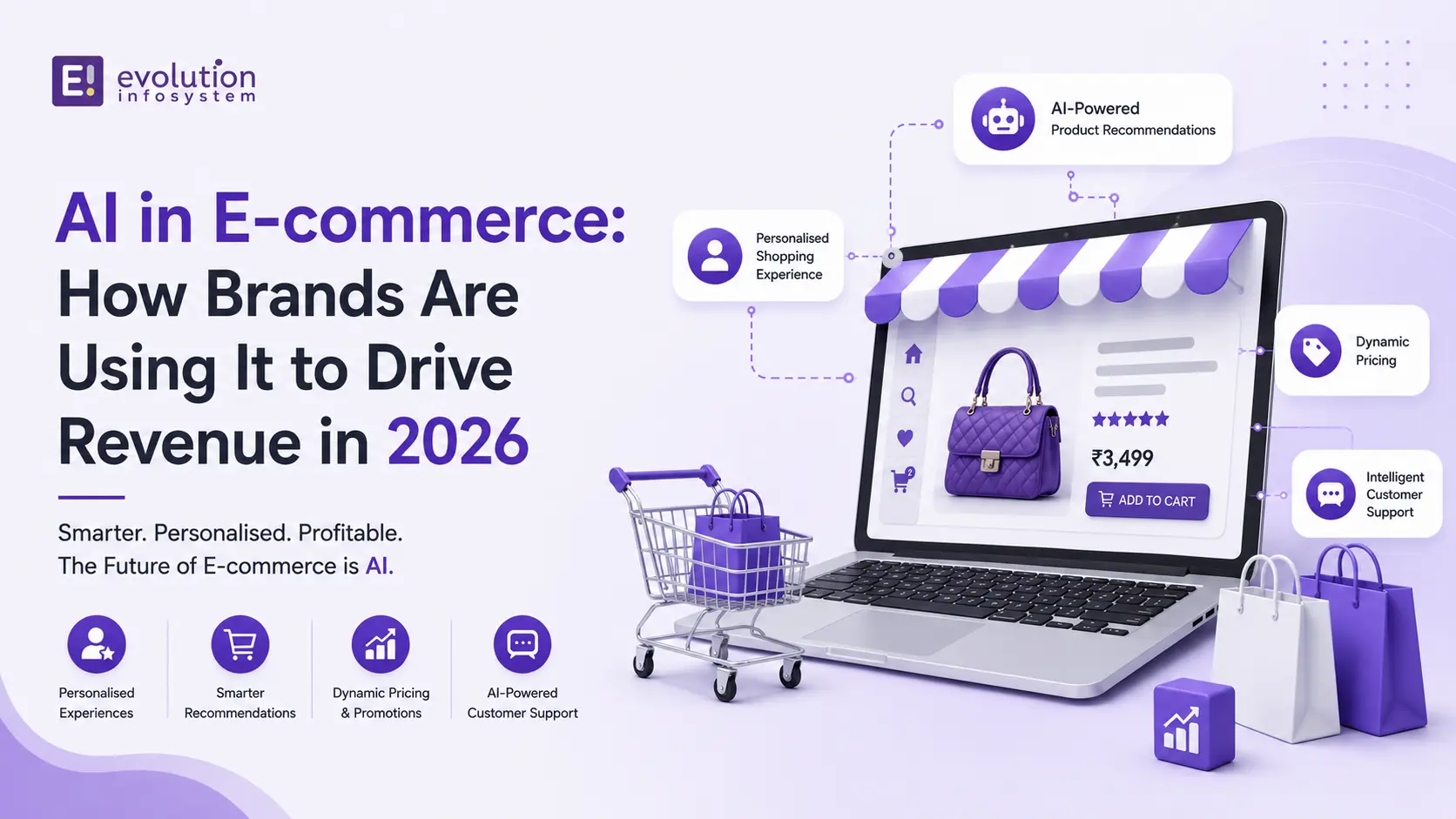
AI is not a future feature for e-commerce. It is the present competitive baseline.
Amazon generates 35% of its total revenue through AI-powered product recommendations. Brands using AI-driven personalization report an average 40% revenue lift. And in 2026, with global e-commerce approaching $7 trillion, the gap between brands that have embedded AI into their commerce stack and those that haven’t is no longer a technology gap – it’s a revenue gap.
This is not about deploying AI because it’s trending. It’s about the specific, measurable ways AI is changing how customers discover products, how brands price them, how support teams operate, and how retention gets built over time.
Here’s where it’s actually happening.
1. Personalization That Goes Beyond “Customers Also Bought”
The era of rule-based recommendations – “customers who bought X also bought Y” – is over. Modern AI recommendation engines analyze hundreds of signals simultaneously: browsing history, purchase patterns, time of day, device type, geographic location, real-time inventory, and even how long a user hovered over a specific product image.
The result is a storefront that is functionally different for every visitor. Not just the product recommendations, but the homepage layout, the search result ranking, the promotional banners, and the email content – all adapted in real time to the individual.
Brands implementing AI-driven personalization at this level consistently report 20–40% improvements in conversion rate and significant increases in average order value. The mechanism is simple: when a customer sees products relevant to their specific taste and behavior, they buy more and they return more often.
Today, the technology to implement this is no longer exclusive to Amazon-scale budgets. Platforms like Nosto, Dynamic Yield, and Bloomreach bring AI personalization to mid-market and enterprise e-commerce operations. For custom-built stores, embedding a recommendation model via API is a straightforward integration.
2. Dynamic Pricing
Static pricing is a structural disadvantage in a market where competitors can change prices algorithmically. AI-powered dynamic pricing adjusts prices in real time based on demand signals, competitor pricing, inventory levels, time sensitivity, and customer segment.
Airlines and hotels have used dynamic pricing for decades. E-commerce is now the same. Brands using AI dynamic pricing report 5–15% margin improvements without meaningful volume loss – because pricing is optimized continuously rather than set once and left.
The implementation ranges from simple rules-based automation (reduce price by X% when inventory exceeds Y units) to full ML models that predict price elasticity by product category and customer segment. For most e-commerce businesses, the middle ground – automated repricing within defined guardrails – delivers the most practical impact.
The important constraint: dynamic pricing done without guardrails damages brand trust. Price transparency and consistency matter to customers. The brands getting this right set pricing floors and ceilings, communicate clearly during promotional events, and don’t let the algorithm undercut their own brand positioning.
3. Visual Search and AI-Powered Product Discovery
Today, a growing share of product searches begin with an image, not a keyword. A customer sees a product on Instagram, screenshots it, and searches for it visually. A shopper finds a chair they like in a magazine and wants to find something similar online.
Visual search closes the gap between inspiration and purchase – the moment where, historically, customers got lost trying to describe in words what they wanted to find.
Pinterest Lens, Google Lens, and dedicated visual search integrations from Algolia and Constructive are the primary tools. For e-commerce brands, implementing visual search requires properly tagged product image libraries, structured product data, and an AI model trained on your catalog. The payoff is a materially shorter path from discovery to purchase for a segment of shoppers who would otherwise bounce.
Closely related: AI-powered search and merchandising. Traditional keyword search breaks when customers use imprecise terms or make spelling errors. AI-powered search understands intent, not just keywords – returning relevant results even when the query is vague, misspelled, or uses different terminology than your product catalog.
4. AI Customer Support and Conversational Commerce
AI chatbots in e-commerce have moved well past the frustrating rule-based systems that gave the category a bad reputation. LLM-powered support agents in 2026 can handle a large share of tier-1 support volume – order status, return initiation, product questions, size guidance – with response quality that customers genuinely find useful.
The business impact runs in two directions simultaneously. Support workload on human agents decreases significantly, allowing them to focus on complex issues that actually require judgment. And conversion improves – customers with questions answered immediately at the point of decision are substantially more likely to complete a purchase than customers who have to wait for email support or navigate an unhelpful FAQ page.
Conversational commerce extends this further. AI agents embedded in WhatsApp, Instagram DMs, and on-site chat don’t just answer questions – they guide product discovery, surface relevant promotions, and complete transactions within the conversation. For mobile-first markets where WhatsApp is a primary communication channel, this is a direct revenue channel, not just a support function.
5. Predictive Inventory and Supply Chain Intelligence
Nothing erodes customer trust faster than discovering a product is out of stock after adding it to cart. Nothing wastes margin faster than overstocking products that don’t move. Both are inventory problems – and both are addressable with AI.
AI-powered demand forecasting uses historical sales data, seasonal patterns, promotional calendars, and external signals (weather, social trends, economic indicators) to predict demand at the SKU level with significantly higher accuracy than manual forecasting. The result is tighter inventory – fewer stockouts, less overstock, better cash flow management.
At the supply chain level, AI monitors supplier lead times, flags delivery risks before they become stockouts, and recommends reorder quantities dynamically. For e-commerce brands with complex, multi-supplier supply chains, this layer of intelligence directly protects revenue during the disruptions that have become a structural feature of global supply chains.
6. Post-Purchase Retention and Churn Prevention
Acquiring a new customer is significantly harder than retaining an existing one. AI applies to retention in ways that are only now being fully exploited by leading brands.
Churn prediction models identify customers who are at risk of lapsing – based on recency, frequency, engagement signals, and behavioral patterns – before they actually churn. This triggers targeted re-engagement: a personalized offer, a relevant product recommendation, or a loyalty incentive timed to the moment of maximum effectiveness.
Post-purchase experience personalization – tailored unboxing content, relevant cross-sell recommendations in order confirmation emails, proactive shipping updates, and personalized review requests – builds the kind of relationship that drives repeat purchase without relying entirely on discount-led retention.
The brands with the highest customer lifetime value in 2026 are not necessarily the ones with the best products or the lowest prices. They’re the ones who use AI to stay relevant to their customers between purchases.
Where to Start
The most common mistake e-commerce brands make with AI is trying to implement everything simultaneously. The right approach is to identify the one part of your funnel with the highest friction or the highest revenue potential, implement AI there first, measure the impact, and expand from that foundation.
For most brands, the highest-impact starting point is either personalized recommendations (directly lifts conversion and AOV) or AI-powered search (reduces the number of customers who can’t find what they’re looking for and bounce). Both are well-supported by mature platforms and deliver measurable results within weeks of implementation.
At Evolution Infosystem, we build AI-powered e-commerce platforms and integrate AI capabilities into existing stores – from recommendation engines and dynamic pricing to conversational commerce and predictive analytics. If you’re ready to close the gap between where your store is and what AI can do for it, let’s talk.
Frequently Asked Questions (FAQs)
How is AI used in e-commerce?
AI is used across the entire e-commerce funnel – personalized product recommendations, AI-powered search, dynamic pricing, visual search, LLM-powered customer support, demand forecasting, and churn prevention. The most commercially impactful applications are personalization (average 40% revenue lift) and AI-driven support (23% conversion improvement).
Does AI personalization actually increase e-commerce revenue?
Yes, measurably. Amazon attributes 35% of its revenue to AI recommendations. Brands implementing AI personalization consistently report 20–40% conversion improvements and higher average order values. The impact scales with the quality of your product data and the volume of behavioral signals available to the model.
What is the difference between AI-powered search and regular site search?
Traditional site search matches keywords exactly – it breaks on misspellings, synonyms, and vague queries. AI-powered search understands intent, returning relevant results even when the query doesn’t match your product catalog terminology precisely. For stores with large catalogs, this difference directly affects how many customers find what they’re looking for and complete a purchase.
Is AI in e-commerce only for large brands?
No. Today, AI personalization, visual search, and chatbot platforms are accessible to mid-market e-commerce businesses. The entry point has dropped significantly as platform-level AI tools have matured. The brands not using AI at any scale are now the exception, not the rule.