AIoT vs IoT: What's the Difference?
Introduction
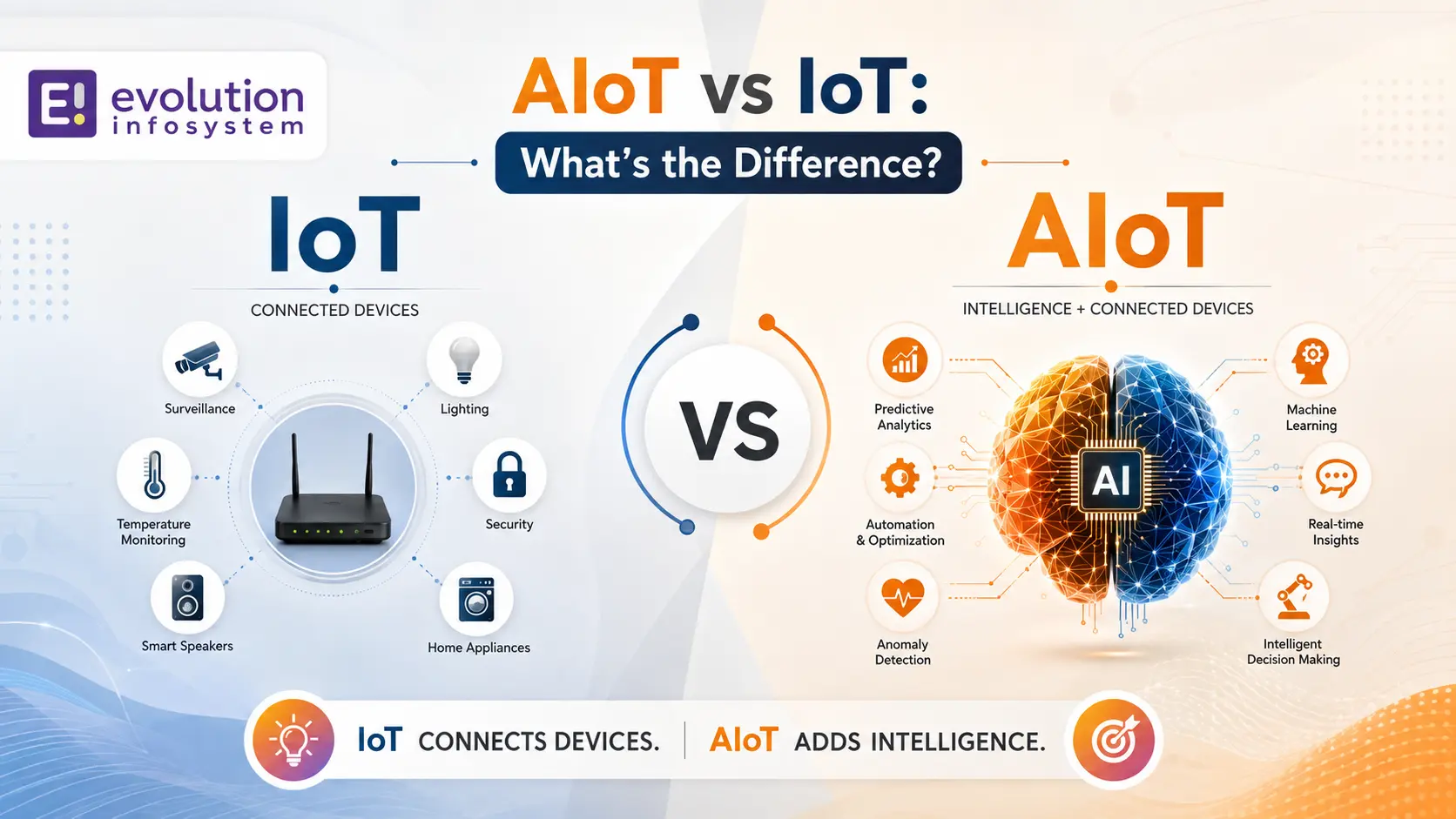
AIoT vs IoT sounds like a subtle terminology shift, but the two represent genuinely different levels of system capability. IoT connects devices and moves data. AIoT adds a layer of intelligence on top, letting those same devices interpret data and act on it without waiting for a human or a distant server to decide.
This guide breaks down what separates the two, how they work together in practice, and which one your project actually needs, because in most real deployments, the answer is not “pick one” but “know where the line between them belongs.”
What Is IoT?
The Internet of Things is a network of physical devices, sensors, and actuators that collect data and exchange it over the internet. A smart thermostat, a warehouse inventory sensor, and a fitness tracker are all IoT devices at their core: they sense something in the physical world and send that information somewhere else for storage or review.
Traditional IoT systems are built around three jobs: sense, connect, and transmit. Decision-making in a classic IoT system is usually handled elsewhere, either by a human reviewing a dashboard or by simple, pre-defined rules running in the cloud. The devices themselves are not doing any real analysis.
What Is AIoT?
AIoT, short for Artificial Intelligence of Things, is what you get when machine learning is embedded directly into an IoT system, either on the device itself or close to it at the network edge. Instead of only reporting what happened, an AIoT system can recognize patterns, predict what is likely to happen next, and take action autonomously.
If IoT is the nervous system, moving signals from sensors to a central point, AIoT is closer to a nervous system with a working brain attached at multiple points along the way. The devices do not just relay information anymore; they interpret it.
AIoT vs IoT: The Core Difference
The clearest way to frame AIoT vs IoT is around one question: where does the thinking happen? In IoT, thinking happens centrally, if it happens through software at all, usually via fixed rules or a human reviewing reports after the fact. In AIoT, thinking happens locally and continuously, often before a human ever sees the data.
That single distinction cascades into everything else. A traditional IoT temperature sensor in a warehouse reports the current reading and triggers an alert if it crosses a fixed threshold someone configured months ago. An AIoT version of the same sensor learns the normal temperature pattern for that specific space across seasons, staffing changes, and equipment cycles, and flags a deviation before it becomes a problem, without anyone having hardcoded the threshold.
AIoT vs IoT: Decision-Making and Autonomy
In classic IoT deployments, decisions are rule-based: if a value crosses X, trigger Y. These rules work fine for simple, predictable scenarios, but they do not adapt. A rule set correctly tuned for a factory floor in winter often misfires in summer, because nothing about the system actually learned anything.
AIoT systems make decisions probabilistically, based on patterns learned from historical and real-time data rather than fixed thresholds. This is what allows AIoT to support genuinely autonomous behavior, adjusting a smart building’s HVAC output in real time based on occupancy patterns, or a manufacturing line rerouting a task the moment a machine-learning model flags early signs of equipment wear.
AIoT vs IoT: Latency and Edge Computing
Latency is one of the most practical differences in any AIoT vs IoT comparison. Traditional IoT often sends raw data to the cloud for processing, then waits for a response before acting. That round trip, however small, adds delay that is irrelevant for a smart thermostat but potentially dangerous for an autonomous vehicle or a robotic arm on a production line.
AIoT frequently relies on edge computing, running inference directly on the device or on a nearby edge server, to cut that latency dramatically. Most production AIoT systems in 2026 use a hybrid model: urgent decisions are made locally at the edge, while more complex model training happens later in the cloud using aggregated data from many devices.
AIoT vs IoT: Real-World Applications
IoT alone still covers a huge share of practical use cases well: asset tracking, basic environmental monitoring, smart lighting, and simple remote control systems, where connectivity and visibility are the actual goal, not autonomous action.
AIoT is where the more advanced use cases live. Predictive maintenance systems that flag a failing motor bearing weeks before it breaks. Smart traffic systems that adjust signal timing in real time based on live congestion patterns rather than a fixed schedule. Computer-vision-equipped quality control on a production line, catching defects a human inspector would miss at full line speed. Smart agriculture systems that adjust irrigation zone by zone based on soil sensor data and weather prediction models, rather than a single timer for the whole field.
AIoT vs IoT: Cost and Complexity
A straightforward IoT deployment is meaningfully cheaper and faster to build. Sensors, connectivity, and a dashboard for visualization cover most requirements, and the engineering work is well understood and low-risk.
AIoT adds real cost and complexity on top of that foundation: data pipelines robust enough to train and retrain models, edge hardware capable of running inference locally, and ongoing model maintenance as conditions change. This is not a reason to avoid AIoT where it is genuinely needed, but it is a reason not to reach for it by default. Every AIoT system starts life as an IoT system with a data pipeline built underneath it; the AI layer is what gets added once that foundation is solid.
AIoT vs IoT: How to Decide Which One You Need
The decision is rarely binary in practice. A useful way to think about it: start with the question a plain IoT system cannot answer for you. If the honest answer is “we just need visibility into what is happening,” IoT alone is very likely sufficient, and building AIoT capability on top of it would be solving a problem you do not have yet.
If the honest answer involves prediction, autonomous action, or pattern recognition across large volumes of sensor data, that is a genuine AIoT requirement, and it is worth designing the data architecture with that end state in mind from day one, even if the AI layer itself gets built in a later phase.
A practical middle path many teams take is deploying IoT first to establish reliable data collection, then layering AI capability in once there is enough real operational data to train a model that will actually be useful, rather than trying to build both at once.
How EVOLUTION Approaches AIoT and IoT Projects
We build both ends of this spectrum, and the right starting point depends entirely on what a client’s system actually needs to do, not on which term sounds more advanced. Our IoT development team handles the connectivity and data foundation: sensors, gateways, and reliable data pipelines that give a business real visibility for the first time.
For projects that need genuine intelligence at the device or edge level, our Edge AI team builds the inference layer that lets devices make decisions locally, without waiting on a round trip to the cloud. For manufacturing and industrial clients specifically, our Industrial IoT practice combines both, connecting legacy equipment and layering predictive intelligence on top where it earns its cost.
For a broader look at where IoT investment is paying off across industries right now, our related post on what’s being built in IoT development and why it matters is a useful starting point before scoping a new project.
Frequently Asked Questions
Is AIoT just IoT with AI added on top?
Not quite. AIoT is the deeper integration of AI directly into device-level or edge-level processing, not simply a machine learning model bolted onto an existing IoT dashboard. Genuine AIoT requires rethinking the data pipeline, hardware, and decision architecture around real-time inference, not just adding analytics after the fact.
Does AIoT require edge computing?
Not strictly, but it is common. AI models can run centrally in the cloud for retrospective analysis, but edge computing becomes necessary when an application needs low latency, reduced bandwidth cost, or stronger data privacy, which describes most real-time AIoT use cases like autonomous systems or industrial robotics.
Is IoT still relevant now that AIoT exists?
Yes. Most IoT use cases, tracking, monitoring, basic automation, do not need predictive intelligence to deliver value. Plain IoT remains the right, lower-cost choice whenever visibility and connectivity are the actual goal rather than autonomous decision-making.
What industries benefit most from AIoT?
Manufacturing, logistics, smart agriculture, healthcare, and smart city infrastructure see the clearest return on AIoT investment, largely because these industries generate high volumes of sensor data where predictive maintenance, real-time optimization, or autonomous response has measurable financial impact.
How much more does an AIoT system cost compared to IoT?
There is no fixed multiplier, but AIoT systems generally cost meaningfully more due to the added data infrastructure, edge hardware, and ongoing model maintenance required. Many teams manage this by building the IoT data foundation first, then adding AI capability once there is enough operational data to justify the investment.
What is the difference between AIoT and IIoT?
They solve different problems. AIoT refers to the addition of artificial intelligence to any IoT system, consumer or industrial. IIoT, Industrial IoT, refers to IoT and AIoT concepts applied specifically to industrial environments with stricter reliability, safety, and real-time performance requirements. The two concepts overlap heavily but are not interchangeable.
Conclusion
The real distinction in AIoT vs IoT is not which term sounds more advanced, it is where the thinking happens in your system. IoT reports what occurred. AIoT interprets it and, increasingly, acts on it without waiting for a human in the loop. Most successful deployments do not start by choosing one over the other; they build a solid IoT data foundation first and add AI capability exactly where it earns its cost.
If you are not sure whether your next project needs IoT, AIoT, or a phased path from one to the other, EVOLUTION’s IoT and AI teams are happy to scope it with you before you commit a budget to the wrong starting point.