ASP.NET Core vs Node.js: Which Backend Is Right for Your Enterprise Application?
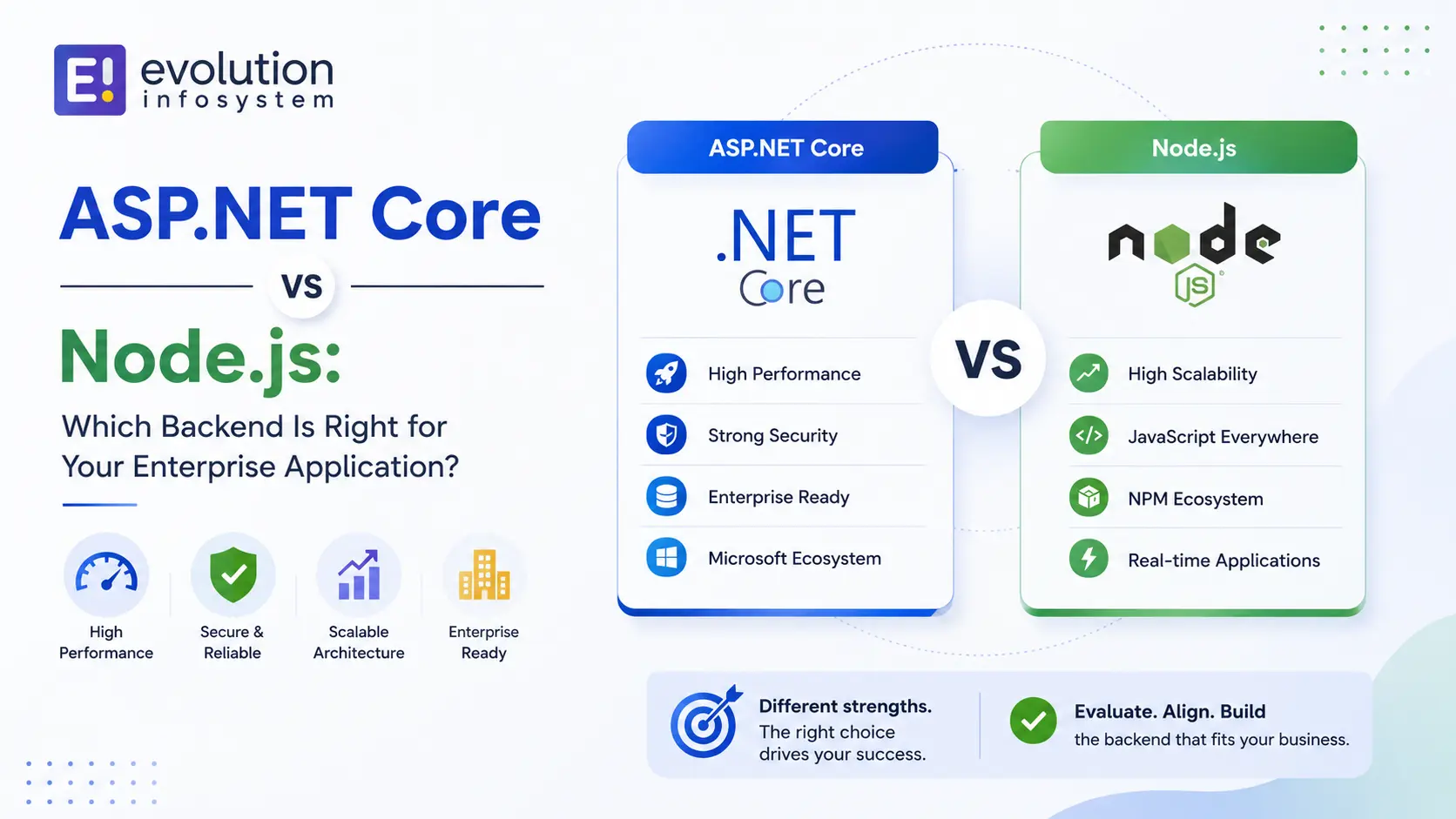
Two backend technologies dominate enterprise web application development: ASP.NET Core (Microsoft’s cross-platform .NET framework) and Node.js (JavaScript on the server). Both power applications at enormous scale. Both have mature ecosystems, strong community support, and enterprise deployments that prove they work.
The question isn’t which one is better. It’s which one is better for your specific context – your team, your existing infrastructure, your performance requirements, and your long-term maintenance reality.
ASP.NET Core vs Node.js is a decision with long-term consequences. Here’s how to make it correctly.
What Each Technology Actually Is
→ ASP.NET Core is Microsoft’s open-source, cross-platform web framework built on .NET. It runs on Windows, Linux, and macOS. Applications are written in C# (primarily) or F#. ASP.NET Core is the foundation for Razor Pages (server-rendered web UI), Blazor (C# in the browser), and Web APIs consumed by frontends or mobile clients. It’s the modern evolution of the original ASP.NET framework, rebuilt from the ground up for performance and cross-platform operation.
→ Node.js is a JavaScript runtime built on Chrome’s V8 engine that allows JavaScript – historically a browser-only language – to run on the server. Express.js, Fastify, and NestJS are the primary web frameworks built on top of Node.js. TypeScript has become the standard for production Node.js applications at scale, adding static typing to JavaScript’s flexibility.
Performance: What the Numbers Actually Mean
Both technologies have achieved benchmark results that make the raw performance comparison largely irrelevant for most enterprise applications. The bottleneck in production enterprise applications is almost never the framework’s request handling speed – it’s database queries, external service calls, and business logic complexity.
That said, the performance profiles of the two differ in specific ways:
→ ASP.NET Core consistently performs at or near the top of enterprise backend framework benchmarks. The TechEmpower framework benchmarks – the most widely cited independent performance comparison – regularly place ASP.NET Core in the top tier for plain text responses, JSON serialisation, and database query performance.
→ Node.js excels at I/O-bound concurrency. Its event-driven, non-blocking architecture handles large numbers of simultaneous connections efficiently, making it particularly strong for real-time applications, WebSocket handling, and any scenario where the server is managing many concurrent connections with relatively light per-request computation.
→ The practical takeaway: for CPU-intensive work (complex calculations, data transformation, ML inference), ASP.NET Core’s compiled C# has measurable advantages. For I/O-bound, high-concurrency scenarios (real-time, streaming, APIs with many simultaneous users), both perform excellently – Node.js’s event loop model has a slight architectural advantage.
For most enterprise web API use cases, this performance distinction doesn’t determine the right choice. Developer productivity, ecosystem fit, and team expertise matter more.
Ecosystem and Libraries
ASP.NET Core’s ecosystem:
- NuGet package ecosystem with 350,000+ packages
- Entity Framework Core – the standard ORM for .NET database access
- SignalR – real-time communication library built into ASP.NET
- Serilog, NLog – structured logging
- FluentValidation, AutoMapper – widely adopted utility libraries
- xUnit, NUnit – mature testing frameworks
- Swagger/OpenAPI – built-in API documentation
Node.js ecosystem:
- npm with 2.5 million+ packages (the largest package registry in the world)
- Prisma, TypeORM, Sequelize – ORMs for Node.js
- Socket.io – real-time communication
- Winston, Pino – structured logging
- Jest, Vitest – widely adopted testing frameworks
- Swagger/OpenAPI – available through packages like swagger-jsdoc
Both ecosystems are mature and well-served. The Node.js npm ecosystem is larger, but “larger” includes a significant amount of abandoned, unmaintained, and low-quality packages. The .NET NuGet ecosystem is smaller but tends to have stronger quality standards and better Microsoft-owned package maintenance.
The Microsoft Ecosystem Advantage
This is where ASP.NET Core has a genuine, often decisive advantage in enterprise contexts.
If your organisation runs Microsoft infrastructure – Azure for cloud, Active Directory for identity, Microsoft 365 for productivity, SQL Server for databases, Dynamics 365 for CRM – ASP.NET Core integrates with all of it natively.
→ Azure integration: ASP.NET Core applications deploy to Azure App Service, Azure Container Apps, and Azure Kubernetes Service with first-class tooling support. Azure AD (Microsoft Entra ID) authentication integrates through the Microsoft.Identity.Web library with minimal configuration.
→ Active Directory: Enterprise authentication through Windows Authentication or Azure AD B2C works out of the box with ASP.NET Core. Implementing the same in Node.js requires third-party passport.js strategies or custom implementation.
→ SQL Server: Microsoft.Data.SqlClient and Entity Framework Core provide mature, well-supported SQL Server integration. The tooling – database migrations, scaffolding, query optimisation through EF Core – is first-party and actively maintained.
→ Visual Studio: For C# developers, Visual Studio provides debugging, profiling, and productivity tooling that has no equivalent in the Node.js ecosystem. Visual Studio Code serves both well, but the deep Visual Studio integration for .NET development is a meaningful productivity advantage.
If your organisation is deeply invested in the Microsoft stack, ASP.NET Core is the natural backend choice. The integration overhead saved by native Microsoft ecosystem support is substantial.
Where Node.js Has the Clear Advantage
→ Full-stack JavaScript consistency.
If your frontend team writes React or Vue, and your backend team writes Node.js, the entire engineering organisation shares one language. Shared TypeScript types between frontend and backend, shared utility libraries, and no context switch between language paradigms. For organisations where frontend and backend engineers collaborate closely or where full-stack engineers span both, this is a genuine productivity advantage.
→ Real-time and streaming applications.
Node.js’s event-driven architecture is particularly well-suited to WebSocket servers, streaming APIs, and real-time collaboration features. While ASP.NET’s SignalR is excellent for real-time in .NET applications, Node.js is the more natural default for teams building real-time systems from scratch without existing .NET investment.
→ Microservices and serverless.
Node.js’s fast cold start time makes it particularly well-suited for serverless functions (AWS Lambda, Google Cloud Functions, Azure Functions with Node.js runtime). For architectures with many small, event-driven functions, Node.js’s lightweight runtime has practical advantages.
→ Developer availability.
JavaScript/TypeScript developers significantly outnumber C# developers in most markets. If hiring is a constraint – and it often is – the Node.js talent pool is deeper.
The Honest Decision Framework
Choose ASP.NET Core when:
- Your organisation runs Microsoft Azure, SQL Server, or Active Directory
- Your engineering team has C# experience
- Your application is CPU-intensive or data-processing-heavy
- You need the strictest possible type safety and compilation-time error detection
- You’re building enterprise line-of-business applications in a regulated industry
Choose Node.js when:
- Your frontend team uses JavaScript/TypeScript and you want language consistency
- Your application is heavily real-time or I/O-bound
- You’re building for a serverless or microservices architecture with many functions
- Your team is JavaScript-native and would face a significant learning curve with C#
- You’re starting a greenfield project without existing Microsoft infrastructure
The honest middle ground: For many enterprise applications, either technology works equally well. When the strategic factors above don’t clearly differentiate, let your team’s expertise be the tiebreaker. The best technology is the one your team can build, debug, and maintain most effectively.
Frequently Asked Questions (FAQs)
Is ASP.NET Core faster than Node.js?
In CPU-intensive workloads and raw throughput benchmarks, ASP.NET Core typically outperforms Node.js. In I/O-bound, high-concurrency scenarios, both perform comparably. For most enterprise web API applications, neither technology’s performance characteristics are the deciding factor – developer productivity, ecosystem fit, and team expertise matter more.
Can Node.js be used for enterprise applications?
Yes. Node.js powers enterprise applications at LinkedIn, Netflix, PayPal, and many Fortune 500 companies. TypeScript has addressed the type safety concerns that previously limited enterprise Node.js adoption. The technology is mature, well-supported, and proven at scale in regulated industries.
What is the main advantage of ASP.NET Core over Node.js?
Native integration with the Microsoft ecosystem – Azure, Active Directory, SQL Server, Visual Studio tooling – is ASP.NET Core’s primary enterprise advantage. For organisations already invested in Microsoft infrastructure, the integration overhead savings are significant. Strong typing through C# and compilation-time error detection are additional advantages for large, long-lived codebases.
Do I need C# experience to use ASP.NET Core?
Yes. ASP.NET Core applications are primarily written in C#. If your team doesn’t have C# experience, the learning curve is real – though for developers with Java or Kotlin backgrounds, C# is approachable. JavaScript/TypeScript developers typically find Node.js a much faster path to productivity.
Which is better for microservices: ASP.NET Core or Node.js?
Both are used extensively in microservices architectures. Node.js has a slight edge for serverless functions due to faster cold start times. ASP.NET Core has advantages in organisations where service-to-service authentication through Azure AD and .NET tooling for distributed tracing fit naturally. The microservices architecture decision should be driven by your service boundary design, not by the technology stack.
At Evolution Infosystem, we build enterprise backends on both ASP.NET Core and Node.js – and we’ll give you a straight recommendation based on your specific context. We won’t recommend a technology because it’s what we prefer to build in. Let’s talk about your enterprise application.