Custom ERP vs Off-the-Shelf: How to Decide
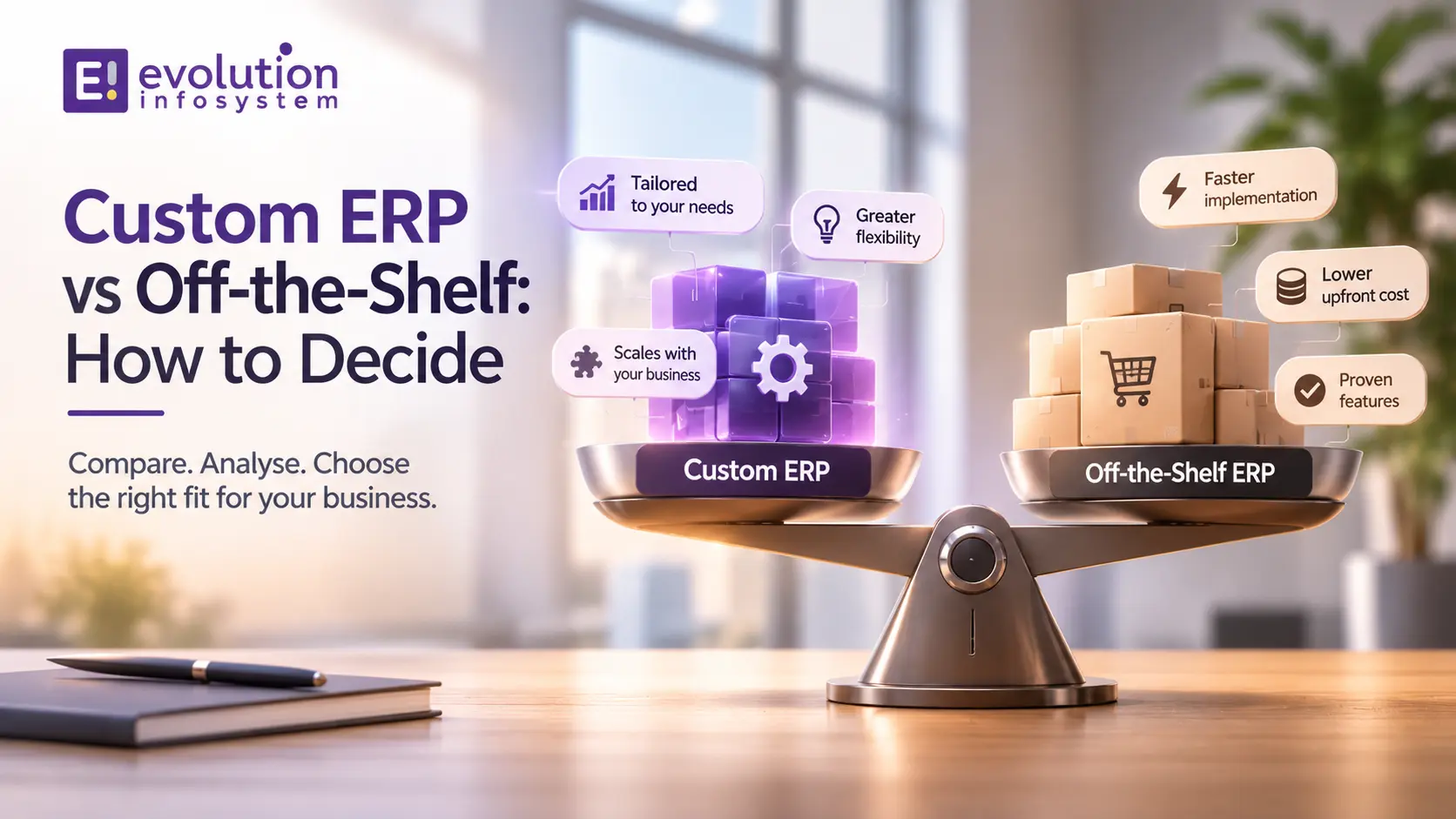
The custom ERP vs off-the-shelf question is one of the biggest software decisions a growing business will face. ERP touches every team, from finance to the warehouse. That makes it painful to change later.
Pick wrong, and you may spend years working around the system, or paying for features you never use. Pick right, and your teams get one clear view of orders, stock, money and people.
This guide gives you a clear way to settle the custom ERP vs off-the-shelf debate. We compare cost, speed, fit and risk. We also give you a ten-question scorecard and a step-by-step process.
At EVOLUTION, we build custom ERP systems, so we have a point of view. But we will tell you honestly when off-the-shelf is the better choice. In a fair custom ERP vs off-the-shelf comparison, there is no universal winner.
Quick answer: In the custom ERP vs off-the-shelf choice, pick off-the-shelf when your processes are standard and you want speed and a lower upfront cost. Pick custom when your processes are your competitive edge, or when licence fees and workarounds would grow faster than the cost of building. Many firms land on a hybrid of both.
Custom ERP vs Off-the-Shelf: What Is the Real Difference?
An ERP system joins finance, inventory, sales, purchasing, HR and production in one place. The custom ERP vs off-the-shelf difference comes down to two things: who designs the system, and whose process it follows.
What Is Off-the-Shelf ERP?
Off-the-shelf ERP is pre-built software that you buy or subscribe to. Well-known examples include SAP S/4HANA, Microsoft Dynamics 365, NetSuite, Acumatica and Odoo. The modules are already built and tested.
You configure the system to fit your business. In many cases, you also adjust your business to fit the system.
What Is Custom ERP?
Custom ERP is software designed and built around the way your business already works. Your workflows, approvals, reports and data rules are part of the design from day one.
This is the other side of the custom ERP vs off-the-shelf coin. You get a close fit, but you also take on more responsibility for design, quality and upkeep.
What Is Hybrid or Low-Code ERP?
Hybrid ERP sits between the two. You start with a packaged core, then add custom modules, workflows or integrations on top. Low-code platforms offer a similar path with visual tools.
Many real-world custom ERP vs off-the-shelf decisions end here, because it blends speed with a closer fit.
Custom ERP vs Off-the-Shelf: Side-by-Side Comparison
The table below shows how the two options compare on the factors that matter most. Details vary by product and project.
| Factor | Off-the-Shelf ERP | Custom ERP |
|---|---|---|
| Upfront cost | Lower | Higher |
| Time to go live | Weeks to a few months | Several months or more |
| Fit to your process | Good for standard processes | Built around your exact process |
| Customisation limits | Set by the vendor | Almost none |
| Ongoing cost | License or subscription fees that grow with users | Maintenance and hosting, no per-seat license |
| Scalability | Depends on vendor tiers and pricing | Designed for your growth path |
| Integrations | Ready connectors, but often extra cost | Built to your systems and APIs |
| Vendor dependence | High | Low, if you own the code |
| Upgrades | Vendor-led, can disrupt custom changes | You decide when and what |
| Main risk | Poor fit and workarounds | Weak design or a weak partner |
Use this table as a first filter in your custom ERP vs off-the-shelf review. Then use the scorecard later in this guide to get a result for your own business.
Pros and Cons of Off-the-Shelf ERP
In the custom ERP vs off-the-shelf debate, off-the-shelf ERP has real strengths. For many companies, it is the safer and faster route.
Pros
- Faster start: the software already exists, so setup can take weeks to a few months
- Lower upfront cost: you do not pay for design and full development
- Proven features: the modules have been used by many other companies
- Built-in best practice: many workflows follow common industry methods
- Vendor support and updates: security patches and new features arrive on a regular basis
- Easier lifetime cost estimate: pricing is published and easier to forecast
Cons
- Licence fees grow: per-user pricing can climb as your team grows
- Fit gaps: if your process is unusual, you may need workarounds
- Vendor roadmap: you depend on the vendor’s plans and pricing changes
- Integration cost: connecting other tools can be costly and complex
- Customisation trap: heavy changes can make upgrades hard and expensive
That last point is often missed in custom ERP vs off-the-shelf talks. One lender’s guide warns that upgrades can be costly if a packaged system has been highly customised, and most ERP systems are upgraded once or twice a year. If you buy, keep changes light.
Pros and Cons of Custom ERP
Custom ERP also has clear strengths and clear risks. A fair custom ERP vs off-the-shelf comparison names both.
Pros
- Exact fit: screens, rules and reports match how your teams really work
- No per-seat licence: adding users does not raise a licence bill
- Competitive edge: you can build features that rivals cannot buy
- Integration control: connect any system through APIs on your terms
- Ownership: you control the roadmap, data model and release dates
- Room to grow: you add modules when you need them, not when a vendor offers them
Cons
- Higher upfront cost: design and development take real investment
- Longer build time: go-live takes months, not weeks
- You carry upkeep: you need a partner or team to maintain and improve it
- Partner risk: a weak builder can leave you with poor code and no documentation
- Scope creep: without discipline, ‘just one more feature’ can stretch the timeline
Custom does not mean building every part from scratch. Modern custom ERP projects use proven frameworks, cloud services and open components. The custom part is your business logic, not the plumbing.
Custom ERP vs Off-the-Shelf Cost: The Full Picture
Cost is the first thing most people ask about in a custom ERP vs off-the-shelf decision. But the sticker price is not the total cost. Look at five years, not five minutes.
What Goes Into Off-the-Shelf Cost
- Licences or subscriptions, often priced per user per month
- Implementation and configuration
- Data migration from old systems
- Integrations with other tools
- Training for your teams
- Internal admin time and vendor support fees
- Upgrades and any rework of custom changes
What Goes Into Custom ERP Cost
- Discovery, process mapping and design
- Development and testing
- Data migration
- Hosting and security
- Ongoing maintenance and improvements
- Documentation and training
One vendor guide estimates a focused custom ERP module at about $20,000 to $50,000, and a full multi-department system at $75,000 to $300,000 or more. It puts yearly maintenance near 15% to 20% of the build cost. Treat these as one vendor’s view, not a rule. Scope drives the price in any custom ERP vs off-the-shelf cost review
A Five-Year Cost Example (Hypothetical)
The numbers below are an illustration, not a quote. They show how the custom ERP vs off-the-shelf cost picture can flip with company size. Replace every number with your own.
Assumptions:
- Custom ERP build: $250,000. Maintenance at 18% a year: $45,000. Hosting: $12,000 a year
- Off-the-shelf licence: $100 per user per month. Admin and vendor support: $20,000 a year
Scenario 1: 100 Users and an Unusual Process
Off-the-shelf: licences of $600,000 over five years, plus $150,000 for implementation, $60,000 for integrations and $100,000 for admin and support. Total: $910,000.
Custom: $250,000 build, plus $225,000 maintenance and $60,000 hosting. Total: $535,000. In this case, custom is about $375,000 cheaper over five years.
Scenario 2: 30 Users and a Standard Process
Off-the-shelf: licences of $180,000 over five years, plus $80,000 for implementation, $30,000 for integrations and $100,000 for admin and support. Total: $390,000.
Custom (same $535,000 total as above): off-the-shelf is about $145,000 cheaper here.
| Five-Year Total | Off-the-Shelf | Custom |
|---|---|---|
| Scenario 1: 100 users | $910,000 | $535,000 |
| Scenario 2: 30 users | $390,000 | $535,000 |
The lesson: in custom ERP vs off-the-shelf cost comparisons, user count and process fit often decide the winner. Per-seat licences punish growth. Custom punishes small scale.
Hidden Costs on Both Sides
- Off-the-shelf: paid add-ons, extra integration tools, consultant fees for workarounds and costly upgrades after heavy customisation
- Custom: scope creep, partner turnover, weak documentation and the cost of rebuilding if the first design was poor
- Both: data clean-up, change management and lost productivity during the switch
Include these in every custom ERP vs off-the-shelf cost model. Skipping them is the most common reason forecasts miss.
When Off-the-Shelf ERP Is the Smarter Choice
In the custom ERP vs off-the-shelf choice, off-the-shelf usually wins when most of these points are true:
- Your processes are standard for your industry
- You need to go live within a few months
- Your upfront budget is tight
- You have a small or stable user base
- You have little in-house IT capacity
- The best packaged ERP already covers most of your needs
Many small and mid-sized firms win the custom ERP vs off-the-shelf question by choosing packaged software and keeping it light. Keep changes in configuration, not in code. That protects your upgrade path.
When Custom ERP Is the Smarter Choice
Custom ERP tends to win when several of these points are true:
- Your process is a real competitive advantage
- Packaged options cover under half of what you need
- You expect many users or fast, unpredictable growth
- You have many legacy or niche systems to connect
- Local rules or industry rules are not covered by global products
- You are tired of paying per-seat fees
- You have a trusted partner to build and maintain it
A clear sign in custom ERP vs off-the-shelf reviews is repeated workarounds. If your team lives in spreadsheets next to the ERP, the fit is wrong. Our guide on custom ERP vs SAP vs Oracle: when to build or buy goes deeper on the big-vendor side.
The Middle Path: Hybrid and Low-Code ERP
The custom ERP vs off-the-shelf choice is not always either-or. A hybrid approach can give you speed and fit at the same time.
Common hybrid patterns include:
- A packaged core for finance and HR, plus custom modules for operations
- A packaged ERP with custom portals and apps built on its APIs
- A low-code layer for special workflows and approvals
Hybrid works best when you connect systems through clean APIs. See our services for REST API development and third-party integrations. You can also read our comparison of Microsoft Dynamics 365 vs custom CRM for a similar trade-off on the customer side.
A 10-Question Scorecard for Custom ERP vs Off-the-Shelf
Use this scorecard to bring structure to your custom ERP vs off-the-shelf decision. Give each question 1, 2 or 3 points, then add them up. Do it with a few team leads, not alone.
| # | Question | 1 Point | 2 Points | 3 Points |
|---|---|---|---|---|
| 1 | How standard are your core processes? | Standard for the industry | Mostly standard | Unique and a competitive edge |
| 2 | How many users in three years? | Under 30 | 30 to 100 | Over 100 or unpredictable |
| 3 | How much would the best packaged ERP cover out of the box? | 80% or more | 50% to 80% | Under 50% |
| 4 | How complex are your integrations? | A few standard tools | Several tools | Many legacy or niche systems |
| 5 | How fast must you go live? | Within 3 to 4 months | 4 to 8 months | 9 months or more is fine |
| 6 | How flexible is your upfront budget? | Tight | Moderate | Flexible, long-term view |
| 7 | Can you maintain custom software? | No IT capacity | Some capacity | Strong team or trusted partner |
| 8 | Do local or industry rules need special features? | None | A few | Many |
| 9 | How worried are you about license fees and lock-in? | Not much | Somewhat | Very |
| 10 | How often will your processes change? | Rarely | Sometimes | Often |
How to Read Your Score
10 to 16 Points: Lean Off-the-Shelf
A packaged ERP is probably the better fit. Pick a vendor that matches your size, and keep customisation light.
17 to 23 Points: Consider Hybrid
You may get the best value from a packaged core with custom modules or integrations. Test this path with a small first phase.
24 to 30 Points: Lean Custom
Custom ERP is likely to fit better and cost less over time. Start with the most valuable modules, not the whole system at once.
A score is a guide, not a verdict. Use it to start a better custom ERP vs off-the-shelf discussion with your team and your finance lead.
Step-by-Step Process to Decide Between Custom ERP vs Off-the-Shelf
Follow these seven steps to reach a decision you can defend. The process works for any size of company.
Step 1: Map Your Processes
Write down how orders, stock, billing, purchasing and reporting really work today. Mark the pain points and the steps that give you an edge. Our guide on what is business process automation can help you spot what to improve first.
Step 2: List Must-Haves and Nice-to-Haves
Turn the map into a short requirements list. Separate must-haves from nice-to-haves. This list is your test for every option.
Step 3: Test Packaged Options Against Your Real Scenarios
Shortlist two or three packaged ERPs. Ask each vendor to demo your real scenarios, not their standard script. Note every gap and every workaround. This fit-gap review is the heart of any custom ERP vs off-the-shelf decision.
Step 4: Get a Custom Estimate
Ask a trusted partner for a phased estimate and a rough timeline. Ask which modules would come first and what you would own at each stage.
Step 5: Build a Five-Year Cost Model
Use the structure from the cost section. Include licences, build, integration, hosting, support and hidden costs. Run it for your expected user count and for a higher one. A good five-year model often settles the custom ERP vs off-the-shelf cost question on its own.
Step 6: Score and Decide
Use the scorecard, the fit-gap results and the cost model together. Share them with finance, operations and IT, and agree on the decision. Write down why you chose it.
Step 7: Phase the Rollout
Start with a pilot or a first module. Plan data migration, training and a fallback plan. For a delivery style that fits phased work, read our comparison of agile vs waterfall vs hybrid.
Implementation Risks and How to Reduce Them
Whichever way the custom ERP vs off-the-shelf choice goes, ERP projects carry risk. Most risks are predictable, and so are the fixes.
| Risk | How to Reduce It |
|---|---|
| Data migration errors | Clean data early, test migrations in stages, keep a rollback plan |
| Low user adoption | Involve users from day one, train in small groups, name champions |
| Scope creep | Fixed phases, a change-request process and a clear backlog |
| Integration failures | Use clean APIs, test every connection, plan for legacy quirks |
| Budget overrun | Milestone budgets, regular cost reviews, a contingency buffer |
| Vendor or partner dependency | Own your data and code, require documentation, keep exit terms |
| Key-person risk | Share knowledge, document decisions, avoid single points of failure |
| Go-live downtime | Run in parallel, choose a quiet period, rehearse the cutover |
Our article on how to automate business workflows without breaking existing systems adds more tips on safe change.
Custom ERP vs Off-the-Shelf by Industry
The right answer often depends on your sector. Here is how the custom ERP vs off-the-shelf choice tends to play out in three common cases.
Manufacturing
Manufacturers need bills of materials, shop-floor tracking, quality checks and traceability. Packaged ERPs cover the basics well. Custom or hybrid often wins when you have unusual production steps or special machines. See our manufacturing ERP service.
Distribution and Retail
These firms need multi-warehouse stock, flexible pricing and online store links. Packaged ERP is often a good start. Custom modules help when you have complex pricing rules or marketplace integrations that standard tools do not cover.
Services and Agencies
Service firms need time tracking, project billing and customer records. Many do well with packaged tools plus light automation. Custom makes sense when your delivery and billing model is unusual. Consider a joined-up approach with custom ERP and CRM development.
Common Mistakes in the Custom ERP vs Off-the-Shelf Decision
Most bad ERP decisions come from the same few mistakes. Watch for these in your own custom ERP vs off-the-shelf process.
- Choosing based on demo polish instead of your real scenarios
- Looking only at upfront cost, not five-year cost
- Customising packaged software too heavily
- Building custom for needs that a packaged tool already solves
- Skipping process mapping before choosing
- Ignoring user adoption and training
- Forgetting data migration effort
- Having no single owner for the ERP project
- Treating the choice as permanent, with no phased plan
How EVOLUTION Helps You Decide and Build
At Evolution Infosystem, we help you work through the custom ERP vs off-the-shelf choice before any code is written. We start with process mapping, a fit-gap review and a five-year cost model, so the decision rests on facts.
If custom or hybrid is the right fit, our custom ERP development team builds in phases, so you see value early. We connect it to your other tools with APIs and use data engineering and business process automation to clean data and remove manual steps. If your systems are moving to the cloud, our cloud migration service can help too.
We are also honest about fit. If a packaged ERP serves you better, we will say so. You can read more in our posts on custom ERP vs SAP and Oracle and on choosing an ERP development company.
Frequently Asked Questions
What Is the Main Difference Between Custom ERP and Off-the-Shelf ERP?
Off-the-shelf ERP is pre-built software that you configure. Custom ERP is built around your own processes. That is the core of the custom ERP vs off-the-shelf difference.
Off-the-shelf is faster to start and cheaper upfront. Custom gives a closer fit and more control, but costs more to build.
Is Custom ERP More Expensive Than Off-the-Shelf ERP?
Upfront, usually yes. Over five years, it depends. Per-user licence fees can make off-the-shelf more expensive for larger teams, while custom can cost more for small, standard businesses.
Our worked example shows both outcomes, so you can see how the custom ERP vs off-the-shelf cost picture can flip.
When Should a Business Choose Custom ERP vs Off-the-Shelf?
Choose off-the-shelf when your processes are standard, you need speed and your budget is tight. Choose custom when your process is a competitive edge, you expect many users or you face many workarounds.
Use the ten-question scorecard in this guide to settle the custom ERP vs off-the-shelf choice for your own case.
Can a Small Business Afford Custom ERP?
Sometimes. Many small firms start with a packaged tool because it costs less upfront. Others build a focused custom module first, for example inventory or billing, and grow it over time.
Phasing is the key. A small custom ERP vs off-the-shelf decision does not have to be all-or-nothing.
Can I Move From Off-the-Shelf ERP to Custom ERP Later?
Yes. Many companies begin with packaged software and move to custom or hybrid as their needs grow. The move is easier if you keep data clean, avoid heavy customisation and use open APIs.
Plan the exit early, so the custom ERP vs off-the-shelf choice you make today does not trap you.
How Long Does It Take to Implement Custom ERP vs Off-the-Shelf?
Off-the-shelf ERP often goes live in weeks to a few months, depending on size and setup. Custom ERP usually takes several months or more, depending on scope.
A phased plan can bring the first custom module live sooner. Timelines in any custom ERP vs off-the-shelf project depend on data quality, integrations and decision speed.
What Are Examples of Off-the-Shelf ERP Software?
Well-known examples include SAP S/4HANA, Microsoft Dynamics 365, NetSuite, Acumatica and Odoo. Each suits a different company size and budget.
Check current features and pricing on each vendor’s site before you compare.
What Is Hybrid ERP and Is It Better?
Hybrid ERP combines a packaged core with custom modules or integrations. It is not always better, but it often gives a good balance of speed, cost and fit.
For many firms, hybrid is the sensible answer in the custom ERP vs off-the-shelf debate.
Final Thoughts
The custom ERP vs off-the-shelf decision is about fit, cost, and control over time. Off-the-shelf wins on speed and upfront cost for standard processes. Custom wins when your process is your edge, or when license fees and workarounds pile up.
Do not guess. Map your processes, test packaged options on real scenarios, build a five-year cost model, and use the scorecard. Then phase the rollout, so you learn early and avoid big bets.
If you want an honest view on custom ERP vs. off-the-shelf for your business, talk to the Evolution Infosystem team. Share your processes and goals, and we will help you choose the route that fits.