Custom ERP vs. SAP vs. Oracle: When to Build and When to Buy
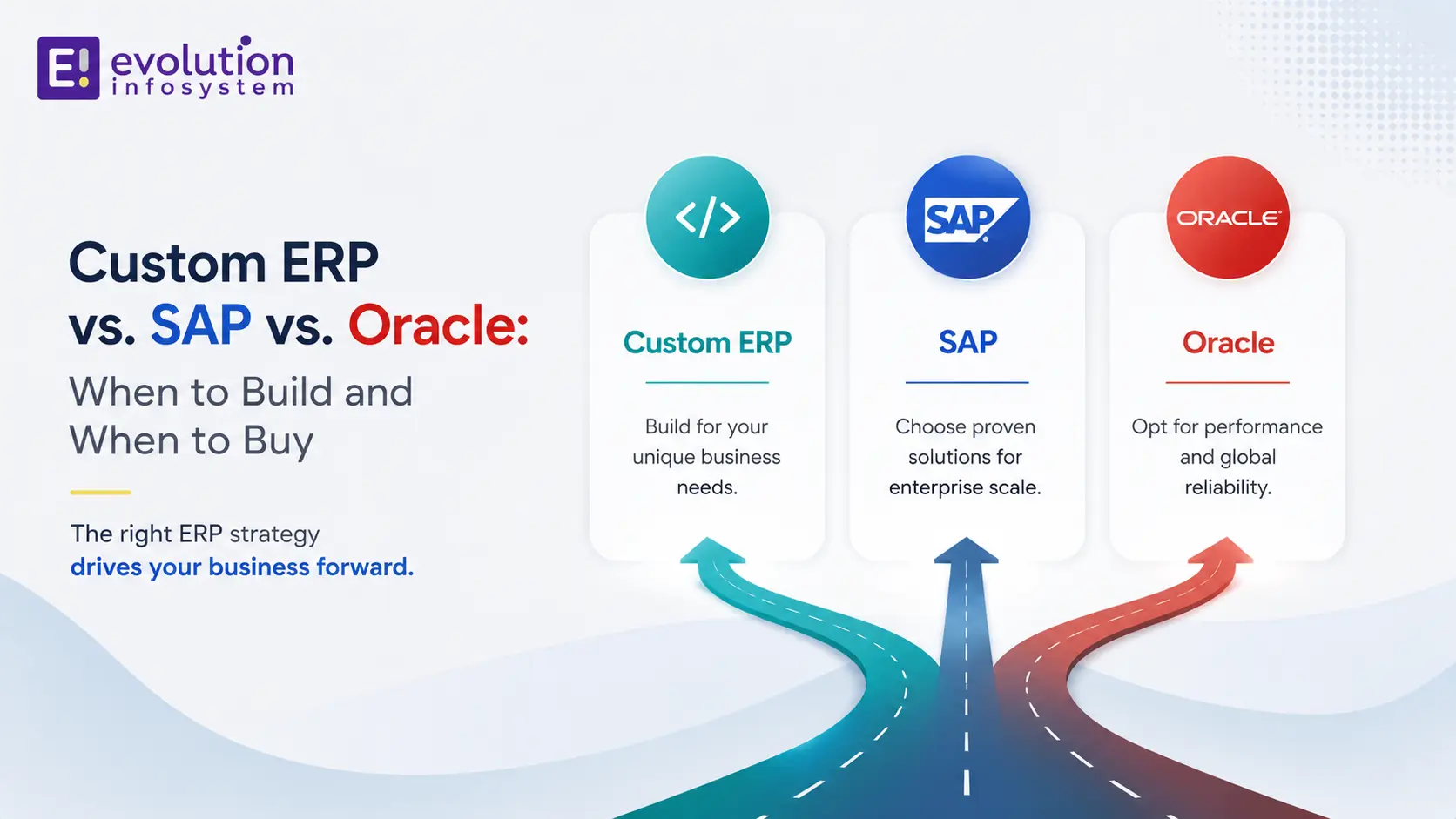
SAP has 425,000 customers globally. Oracle ERP has hundreds of thousands more. Both are billion-dollar products built by thousands of engineers over decades. And yet, a significant number of businesses – particularly mid-market manufacturers, distributors, and service operations – would be better served by a custom ERP system than either of them.
This is not a contrarian take for the sake of it. It’s a practical observation about fit. SAP and Oracle are built for the average of every business in their target segment. If your operations match that average closely enough, they work extremely well. If they don’t – if your processes are genuinely different from the template – you spend more on configuration and customisation than the software itself cost, and you end up with a system your operations team bends their processes to fit, rather than software that fits your operations.
Here’s how to figure out which situation you’re in.
What Off-the-Shelf ERP Actually Gives You
SAP, Oracle, Microsoft Dynamics, and their mid-market equivalents (NetSuite, Sage, Infor) give you a pre-built system covering the major business functions: finance and accounting, procurement, inventory management, order management, HR and payroll, manufacturing, and reporting.
The advantages are real:
→ Maturity.
These systems have been used by thousands of businesses across every edge case imaginable. The logic is battle-tested. The bugs have been found and fixed over decades.
→ Ecosystem.
Integrations with third-party systems, certified implementation partners, community resources, and trained professionals who know the system deeply.
→ Compliance.
Built-in support for accounting standards, tax regulations, and industry-specific compliance requirements across multiple jurisdictions.
→ Faster initial deployment.
Compared to building from scratch, deploying a configured off-the-shelf ERP is faster – in theory. In practice, the gap narrows significantly as customisation requirements grow.
The limitations are equally real:
→ Configuration ceiling.
Every off-the-shelf ERP has a configuration ceiling – the point beyond which the system’s architecture can’t be adapted to your requirements without custom development on top of the platform. That custom development often costs more than the licence.
→ Process compromise.
Standard ERPs are built around standard processes. If your competitive advantage is in a non-standard process – a unique manufacturing workflow, a distinctive service delivery model, a proprietary pricing logic – you’re either compromising that process to fit the software or building custom modules to preserve it.
→ Licence and implementation costs.
SAP and Oracle enterprise implementations routinely run into the millions. For mid-market businesses, this is often more than the custom alternative.
→ Ownership.
You don’t own the roadmap. Features you need may not arrive. Features you don’t need create noise. Upgrades are often expensive, disruptive, and non-optional.
What a Custom ERP Actually Is
A custom ERP is a purpose-built enterprise software system designed specifically around your business processes, data model, and operational requirements.
It is not a spreadsheet. It is not a collection of disconnected applications. It is a unified system – covering the same functional areas as SAP or Oracle – built on a modern technology stack, designed around your exact workflows, and owned entirely by you.
A well-built custom ERP includes:
→ Unified data model.
One database that your finance, inventory, procurement, production, sales, and HR functions all read from and write to. No data duplication, no synchronisation lag, no reconciliation between systems.
→ Process-aligned workflows.
Approval flows, data entry screens, reporting views, and automation rules designed around how your business actually operates – not how a generic template says it should.
→ Integration layer.
Clean APIs connecting your ERP to the systems around it – your e-commerce platform, your logistics providers, your payment processors, your banking systems, your supplier portals.
→ Role-based access.
Each user sees exactly what they need and nothing they don’t. Permissions designed around your actual organisational structure, not a generic role hierarchy.
→ Scalable architecture.
Built on technologies that scale with your business. Adding a new warehouse, a new product line, a new business unit, or a new country is a configuration change, not a rebuild.
The Decision Framework: Build vs. Buy
Run your situation through these five questions. The answers determine which direction makes sense.
1. How standard are your core processes?
If your finance process is standard, your procurement process is standard, and your inventory management process is standard – the processes that SAP and Oracle were built for – there’s no compelling reason to build. The off-the-shelf system does what you need.
If your processes are meaningfully different from the standard template – and the difference isn’t a quirk you could adapt to, but a genuine operational distinction your business depends on – custom ERP is worth evaluating seriously.
2. How much will off-the-shelf configuration cost?
The sticker price of an off-the-shelf ERP is rarely what you pay. Add implementation consulting, customisation to meet non-standard requirements, data migration, training, and annual licence fees. For mid-market businesses, a fully implemented SAP or Oracle system often runs significantly more than a purpose-built alternative.
Get a realistic total cost of ownership estimate for the off-the-shelf path before comparing it to a custom build.
3. What is your competitive differentiation?
If your operational processes are where you compete – your manufacturing precision, your service delivery speed, your unique supply chain model – forcing those processes into a generic ERP template is a real competitive disadvantage. A custom ERP that preserves and enables your operational differentiation is a strategic asset.
If your competitive differentiation is in your products, your relationships, or your market position rather than your operations, standard ERP processes are fine.
4. What is your data situation?
A custom ERP’s data model can be designed around your exact entities: your product variants, your customer hierarchy, your supplier relationships, your production stages. Off-the-shelf ERP data models are generic. Fitting your data into a generic model that doesn’t quite match your reality creates persistent workarounds, reporting compromises, and data quality problems.
5. What is your long-term control requirement?
With off-the-shelf ERP, you’re dependent on the vendor’s roadmap, pricing decisions, and upgrade cycle for the life of the system. With a custom ERP, you own the system. You decide what gets built, when it gets built, and what it costs to maintain. For businesses where the ERP is a core operational system rather than a commodity tool, ownership matters.
What Custom ERP Development Actually Looks Like
A misconception about custom ERP is that it means starting from scratch with no foundation. Modern custom ERP development uses established frameworks, libraries, and architectural patterns – the custom part is the business logic, data model, and user experience, not the underlying infrastructure.
A typical custom ERP development engagement:
→ Discovery phase (4–6 weeks).
Deep process mapping across all functions in scope. Every workflow documented. Every data entity defined. Every integration requirement identified. This phase determines whether the build is straightforward or complex, and it produces the specification that everything else is built against.
→ Architecture and design (2–4 weeks).
Technology stack selection, database design, API architecture, security model, and role hierarchy. UI/UX design for the primary workflows.
→ Development in modules (12–24 weeks depending on scope).
Built in functional modules – finance first, then inventory, then procurement, and so on – with each module tested before the next begins. This allows early validation and course correction.
→ Integration development (parallel with module development).
API integrations with external systems built alongside the core modules, not bolted on at the end.
→ User acceptance testing (4–6 weeks).
Real users testing real workflows against real data. Not a checkbox exercise – the phase where process gaps and usability issues are caught before go-live.
→ Phased go-live.
Department by department or function by function, not a big-bang cutover. Reduces go-live risk significantly.
Industries Where Custom ERP Consistently Wins
→ Manufacturing with non-standard production flows.
Standard ERP production modules assume standard production flows. Businesses with complex BOM (bill of materials), multi-stage production with yield variability, or job-shop manufacturing benefit significantly from a custom ERP designed around their specific production model.
→ Distribution with unique pricing logic.
Businesses with complex customer-specific pricing, contract pricing tiers, or volume discount structures that don’t fit standard ERP pricing modules consistently find custom ERP more practical than configuring around a system that wasn’t built for their model.
→ Professional services with project-based operations.
Businesses where the core operational unit is a project – consulting firms, engineering firms, creative agencies – often find that project-centric custom ERP fits their reality better than systems designed around product inventory.
→ Multi-entity businesses with complex consolidation.
Businesses operating across multiple legal entities, currencies, or regulatory jurisdictions benefit from a custom ERP data model designed specifically for their consolidation requirements.
Frequently Asked Questions (FAQs)
Is a custom ERP better than SAP?
Not universally. SAP is better when your processes are standard, your compliance requirements align with SAP’s built-in features, and you have the resources for a full SAP implementation. A custom ERP is better when your processes are genuinely non-standard, the cost of SAP configuration and customisation is high relative to a purpose-built alternative, or operational ownership and flexibility matter to your business.
How long does custom ERP development take?
A focused custom ERP covering 3–4 core functional areas (finance, inventory, procurement, and order management, for example) typically takes 6–9 months to build and deploy. A broader system covering 6+ functional areas with complex integrations takes 12–18 months. The primary variables are scope, integration complexity, and data migration requirements.
What does custom ERP development involve?
Custom ERP development involves process discovery and mapping, database and API architecture design, modular development of each functional area, integration with external systems, user acceptance testing, and phased deployment. A good custom ERP engagement starts with thorough process documentation – the build is only as good as the specification it’s built against.
What is the difference between ERP and CRM?
ERP (Enterprise Resource Planning) manages internal operations – finance, inventory, procurement, manufacturing, HR. CRM (Customer Relationship Management) manages customer-facing processes – lead management, sales pipeline, customer communication, and conversion analytics. The two systems are complementary and often integrated, but they serve different functions. Many custom ERP builds include a CRM module designed to share the same data model and customer records as the operational ERP.
At Evolution Infosystem, we build custom ERP systems for manufacturing, distribution, professional services, and retail organisations. We’ve built custom ERP where SAP was the alternative – and in the right circumstances, we’ve also told clients that SAP was the better answer. If you’re evaluating the build vs. buy decision for your ERP and want a straight opinion, let’s talk.