Headless Commerce: What It Is, When You Need It, and When You Don't
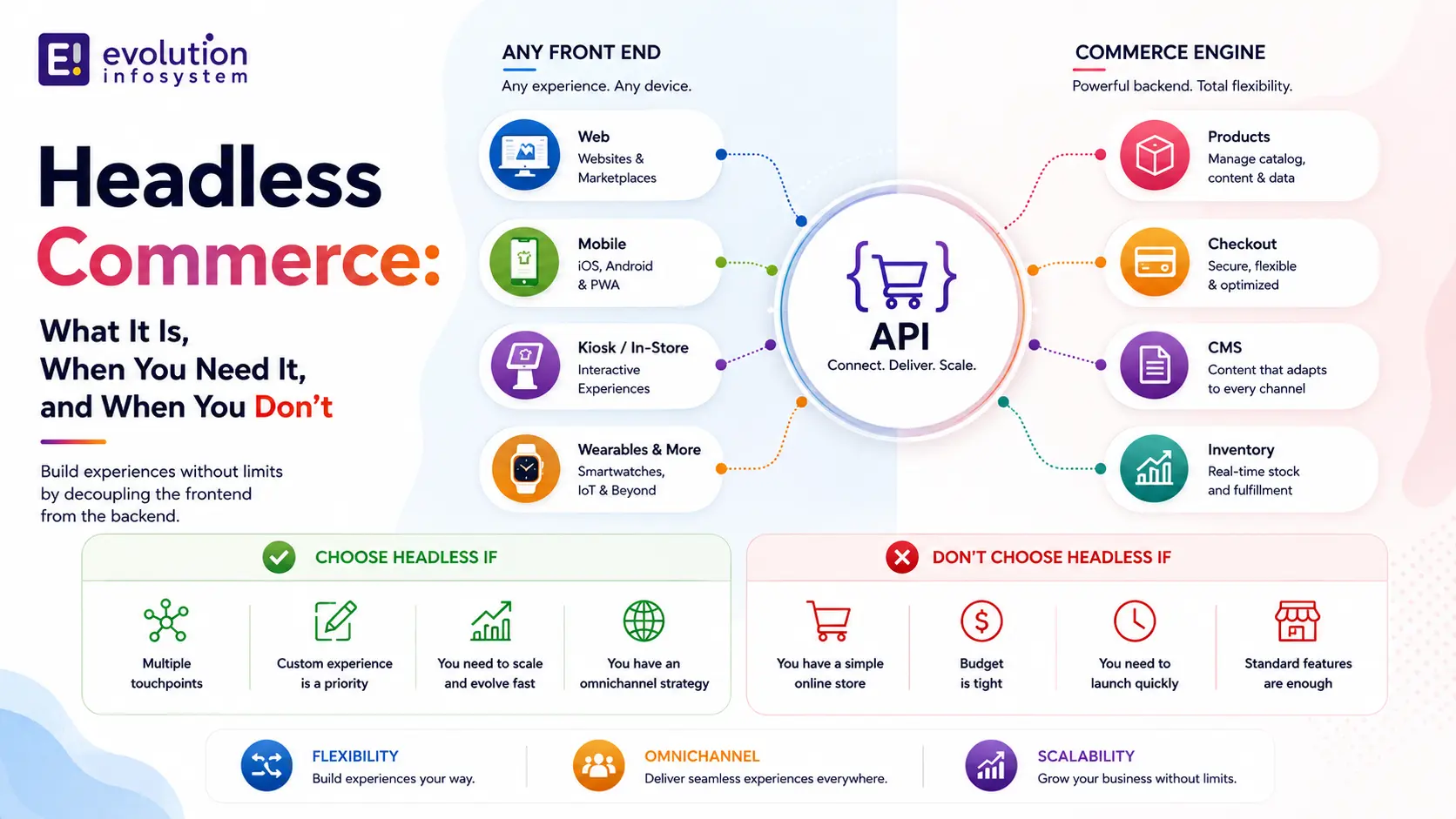
Headless commerce is one of the most discussed architectural patterns in e-commerce – and one of the most frequently adopted for the wrong reasons. The technology is real, the benefits are genuine, and for the right businesses, headless architecture delivers performance and flexibility that traditional platforms cannot match.
For the wrong businesses, it adds significant engineering complexity, ongoing maintenance overhead, and a longer time-to-market for no meaningful gain.
Here’s a clear-eyed breakdown.
What Headless Commerce Actually Means
In a traditional e-commerce platform – standard Shopify, WooCommerce, Magento – the frontend(what customers see and interact with) and the backend (commerce logic: catalog, cart, checkout, payments, inventory) are tightly coupled. The platform controls both. You work within its templates, its theme system, and its rendering engine.
Headless commerce decouples the frontend from the backend. The backend – your commerce engine – handles all the business logic and exposes it via APIs. The frontend is built entirely separately, using any technology you choose, consuming those APIs to render the storefront experience.
The “head” in headless refers to the frontend. Removing it from the platform and replacing it with a custom-built frontend is what makes the architecture headless.
What This Unlocks
→ Complete frontend freedom.
When the frontend is decoupled from the commerce engine, it can be built with any technology – Next.js, React, Vue, Nuxt – using modern development practices that traditional platform themes don’t allow. The result is typically faster page loads, better Core Web Vitals scores, and a storefront that behaves and performs exactly as designed rather than within the constraints of a theme system.
→ True omnichannel delivery.
The same backend APIs that power your web storefront can power a mobile app, a kiosk, a voice interface, a smart TV application, or an AR shopping experience – without building separate commerce backends for each. One commerce engine, multiple frontend surfaces. This is the architecture that makes genuine omnichannel commerce operationally manageable rather than theoretically possible.
→ Performance at scale.
Headless storefronts built on modern JavaScript frameworks with static generation and edge delivery can achieve sub-second load times globally. For high-traffic e-commerce, the performance advantage over traditional platform-rendered storefronts is measurable in conversion rate – and at scale, that difference is significant.
→ Independent scaling.
The frontend and backend scale independently. A high-traffic sale event stresses the frontend (traffic and rendering) differently from the backend (order processing and inventory). Headless architecture lets you scale each layer for its specific load profile rather than scaling everything together.
The Real Trade-offs
Headless commerce is not a free upgrade. The trade-offs are real and need to be understood before committing to the architecture.
→ Engineering complexity.
A traditional Shopify store can be managed by a competent marketing team with basic technical support. A headless Shopify implementation requires a dedicated frontend engineering team. Someone needs to own the frontend codebase, manage deployments, handle performance monitoring, and integrate new backend features as the commerce platform evolves. This is a permanent engineering overhead, not a one-time build.
→ Time to market.
Building a custom frontend is slower than launching on a platform theme. For brands that need to move fast – new product launches, seasonal campaigns, rapid A/B testing – the speed advantages of traditional platforms matter. Headless adds a development dependency to every frontend change.
→ App ecosystem limitations.
Traditional platforms like Shopify have vast app ecosystems where functionality can be added in minutes. In headless architectures, many of these apps either don’t work without modification or require custom integration work to surface their functionality in the custom frontend. Third-party reviews, loyalty programs, upsell widgets, and live chat tools all need to be re-integrated at the frontend level.
→ Checkout complexity.
For Shopify headless implementations, the checkout is often still Shopify’s hosted checkout – because building a compliant, conversion-optimized checkout from scratch is genuinely hard. The flexibility of headless can paradoxically reduce flexibility at the most conversion-critical point of the purchase journey.
When You Actually Need Headless Commerce
→ Your current platform’s frontend is a genuine performance ceiling.
If your PageSpeed scores are consistently poor despite theme optimization, if your platform’s rendering architecture is preventing you from achieving the Core Web Vitals scores your business requires, and if performance is directly correlated with conversion and revenue in your market – headless is a legitimate architectural solution.
→ You need to deliver commerce across multiple surfaces.
If your roadmap includes a mobile app, an in-store kiosk, a B2B buyer portal, and a consumer web storefront – all sharing the same product catalog, pricing, and inventory – headless architecture is the right foundation. Managing four separate commerce backends for four surfaces is operationally unsustainable.
→ Your design and UX requirements exceed what platform themes support.
If your brand experience requires interactions, animations, or layouts that can’t be built within a theme system, headless removes that constraint.
→ You’re at a scale where the engineering investment is justified.
Headless commerce makes sense when the revenue impact of performance improvements, the operational benefit of omnichannel architecture, or the competitive advantage of complete design freedom outweighs the engineering investment required to build and maintain it.
When You Don’t Need Headless Commerce
→ You’re an early-stage or mid-market brand without a dedicated frontend engineering team.
If you don’t have the engineering capacity to own a custom frontend codebase, headless will slow you down rather than accelerate you. The right move is Shopify 2.0 with a well-built custom theme – you get significant performance and flexibility improvements without the overhead.
→ Your primary need is content marketing and SEO, not extreme performance.
A well-optimized Shopify 2.0 theme can achieve strong Core Web Vitals scores. If you’re not pushing the limits of what platform themes can deliver, headless adds complexity without proportionate benefit.
→ You need to move fast on merchandising and campaigns.
Marketing teams that need to launch campaigns, update collections, and run A/B tests quickly are significantly faster on traditional platforms. Headless development cycles slow this down.
→ Your conversion funnel doesn’t have a performance problem.
If your current store converts well, loads acceptably, and serves your business requirements, headless is an expensive solution to a problem you don’t have.
Composable Commerce: The Next Evolution
Beyond headless, composable commerce extends the decoupling further – breaking the backend itself into independent, best-of-breed microservices. Rather than a single commerce engine for catalog, cart, checkout, search, and OMS, each function is a separate service from the best vendor for that capability, composed through APIs.
Composable commerce is the architecture of the largest, most complex e-commerce operations in the world. It offers maximum flexibility and zero vendor lock-in at the cost of substantial integration complexity and organizational maturity requirements. For most businesses, composable commerce is a future consideration – something to architect toward as scale and complexity grow, not a starting point.
Frequently Asked Questions (FAQs)
What is the difference between headless commerce and traditional e-commerce?
In traditional e-commerce, the frontend and backend are tightly coupled within the platform. In headless commerce, the frontend is decoupled and built separately, consuming backend commerce functionality via APIs. Headless provides complete frontend freedom and omnichannel capability at the cost of additional engineering complexity.
Is headless commerce worth it in 2026?
For high-traffic brands with dedicated frontend engineering teams, omnichannel requirements, or performance demands that exceed platform theme capabilities – yes. For early-stage and mid-market brands without frontend engineering capacity, a well-built custom theme on Shopify 2.0 or WooCommerce delivers most of the benefits with significantly less overhead.
What platforms support headless commerce as of 2026?
Shopify (via Storefront API and Hydrogen framework), Commercetools, BigCommerce, Contentful Commerce, and custom API-based backends all support headless implementations. Shopify Hydrogen, built on Remix, is the most accessible entry point for headless Shopify development.
What is composable commerce?
Composable commerce extends headless architecture by also decoupling the backend into independent microservices – separate best-of-breed solutions for catalog, search, cart, checkout, and OMS – composed through APIs. It offers maximum flexibility for large, complex operations at the cost of significant integration and organizational complexity.
At Evolution Infosystem, we build both headless storefronts and well-optimized traditional platform implementations – and we’ll tell you honestly which one your business actually needs. If you’re evaluating headless commerce and want a straight assessment of whether it’s the right architectural choice for your situation, let’s talk.