How to Build an MVP the Right Way: A Technical Roadmap for Startups in 2026
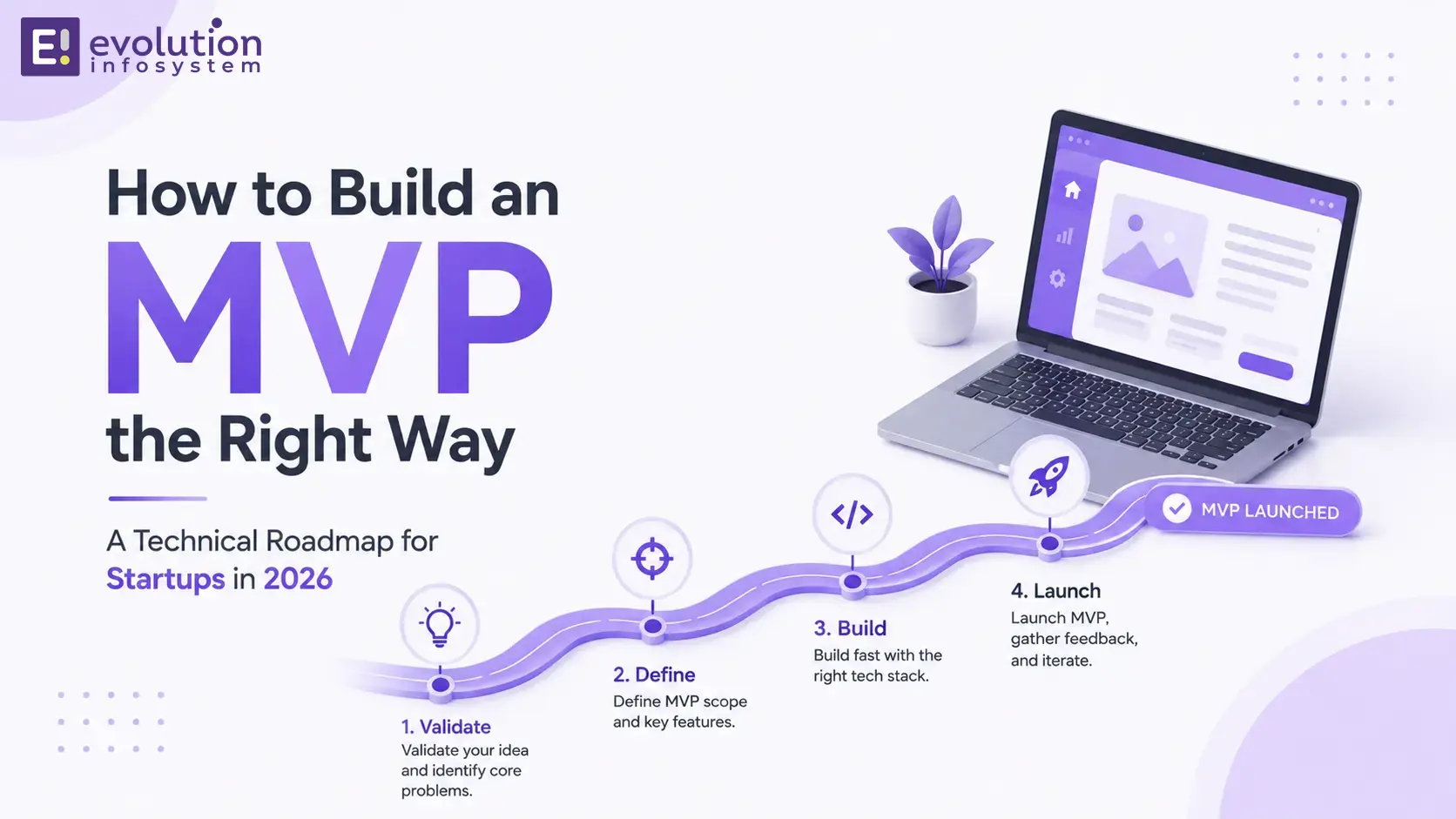
Most startups don’t fail because they can’t build. They fail because they build the wrong thing, at the wrong scope, with the wrong assumptions baked in – and by the time they realise it, they’ve burned through half their runway.
Building an MVP in 2026 is faster than it’s ever been. The tools are better. The frameworks are more mature. AI accelerates development. But speed without direction is still expensive. This guide gives you the technical roadmap to build an MVP that actually validates your idea – without over-engineering, over-spending, or launching something nobody asked for.
What an MVP Is (And What It Isn’t)
A Minimum Viable Product is the simplest functional version of your product that delivers real value to real users and generates real feedback. It is not a prototype. It is not a proof of concept. It is not a demo. It is a working product with an intentionally limited scope.
MVP vs. POC vs. Prototype:
| MVP | Proof of Concept (POC) | Prototype | |
|---|---|---|---|
| Purpose | Validate market demand | Validate technical feasibility | Validate UX and flows |
| Users | Real users | Internal/stakeholders | Test users |
| Functional? | Yes | Sometimes | Sometimes |
| Data generated | User behaviour, retention, revenue | Technical benchmarks | UX feedback |
| Typical timeline | 8–16 weeks | 2–4 weeks | 2–6 weeks |
The MVP’s job is to answer one question: will real users pay attention to (and ideally pay for) this product? Everything you build should serve that question and nothing else.
In 2026, the biggest MVP mistake is still the same one from 2016: building too much. Research consistently shows that 70% of MVP failures stem from scope creep – teams build 15 features when 3 would have provided the same validation signal, faster and cheaper.
Phase 1: Define the Problem Before You Define the Product
Before a single wireframe, line of code, or technology decision, define the problem with precision.
You need answers to:
- Who exactly is the user? Not “SMBs” – which role, which industry, which company size?
- What is the specific problem they experience? Describe it in their words, not yours.
- How are they solving it today? If there’s no existing solution, why not?
- What does success look like for them after using your product?
- How will you know if your MVP has solved the problem?
Validation before build: In 2026, investors expect founders to demonstrate demand before Series A. That standard has filtered down to the seed stage too. Run customer discovery – 15–20 conversations with your target user – before committing to a build. If you can’t find 15 people willing to spend 30 minutes discussing the problem, you may not have a problem worth solving.
Phase 2: Define Scope Ruthlessly
The MVP scope decision is the most consequential one you’ll make.
Every feature you add:
- Increases build time (non-linearly – features interact with each other)
- Increases the test surface
- Increases maintenance burden
- Delays your first learning
The MoSCoW framework for MVP scoping:
- Must-have: The core workflow that delivers the product’s primary value. Without these, the product doesn’t work.
- Should-have: Features that improve the experience but don’t block the core workflow.
- Could-have: Nice-to-haves. Cut all of these from the MVP.
- Won’t-have (now): Explicitly documented features deferred to post-validation.
A well-scoped MVP has 3–5 must-have features. If you have more than 7, you’re building a v1 product, not an MVP. Cut harder.
The acid test for every feature: “If we remove this, does the user fail to experience the core value?” If the answer is no, it’s not a must-have.
Phase 3: Choose Your Tech Stack
The right tech stack for an MVP in 2026 is the one your team moves fastest with, that scales to your first 10,000 users without a rebuild, and that attracts the engineers you’ll need to hire later.
The pragmatic 2026 MVP stack for most web-based products:
| Layer | Recommended | Why |
|---|---|---|
| Frontend | Next.js + TypeScript | 44.7% developer adoption, SSR, SEO-friendly, largest ecosystem |
| Backend | Node.js or Python (FastAPI/Django) | TypeScript consistency or AI/ML-friendly Python |
| Database | PostgreSQL via Supabase | #1 database at 55.6% adoption, includes auth, storage, real-time |
| Hosting | Vercel (frontend) + Railway/AWS | Fast deployment, generous free tiers |
| Auth | Supabase Auth, Clerk, or Auth0 | Never roll your own auth |
| Payments | Stripe | No real alternative for B2B SaaS in 2026 |
| AI layer | OpenAI / Anthropic API + LangChain | If your product requires AI capabilities |
For mobile MVPs: React Native or Flutter for cross-platform (one codebase, two platforms). Only go native if your product requires deep device hardware access.
The rule to follow: Build your MVP on technologies your team already knows. Do not learn a new framework on your MVP’s budget. The 2026 landscape is full of shiny new tools – ignore them until v2.
What NOT to do:
- Don’t start with microservices. A monolith is appropriate for MVP and scales further than most teams think.
- Don’t build a custom auth system. It will take weeks and introduce security vulnerabilities.
- Don’t over-provision infrastructure. Start on managed, serverless infrastructure and scale when you have the problem of too many users.
Phase 4: Build in Tight, Focused Sprints
MVP development should follow an 8–12 week sprint structure with clear weekly milestones. This keeps the scope tight and forces prioritisation decisions at regular intervals.
Recommended 12-week MVP timeline:
| Weeks | Focus |
|---|---|
| 1–2 | Core backend architecture, database schema, authentication, CI/CD pipeline setup |
| 3–5 | Primary feature development – the must-have workflow from end to end |
| 6–7 | Frontend UI, integrations, basic analytics, error handling |
| 8 | QA testing, bug fixes, performance checks, security review |
| 9 | Beta launch to 20–50 target users, feedback collection begins |
| 10–12 | Iteration based on real user behaviour, not assumptions |
Non-negotiables from week one:
- Set up analytics (Mixpanel, PostHog, or Amplitude) before launch. If you’re not measuring user behaviour from day one, you’re flying blind.
- Set up error monitoring (Sentry). You need to know about bugs before your users report them.
- Set up CI/CD. Manual deployments slow you down and introduce risk.
Phase 5: Launch to a Small, Specific User Group
Don’t launch to everyone. Launch to the 20–50 users who most closely match your ICP and who gave you the strongest signal during customer discovery.
Controlled launches in 2026 serve three purposes:
- You get high-quality feedback from users who understand the problem well
- You can handle early support manually without infrastructure
- You don’t burn your broader market on an unpolished first version
What to measure at launch:
- Activation rate: Did users complete the core workflow at least once?
- Retention at 7 days and 30 days: Did they come back?
- NPS (Sean Ellis test): How would users feel if the product disappeared? Aim for 40%+ responding “very disappointed.”
- Core action frequency: How often are users performing the primary value action?
Vanity metrics – sign-ups, page views, downloads – tell you nothing useful at this stage. Focus on engagement and retention.
Phase 6: Iterate Based on Evidence, Not Opinion
The MVP launch is not the destination. It is the beginning of the learning process.
After your first two weeks with real users, you will have three categories of feedback:
- Validation signals: Users are returning, completing the core workflow, and expressing genuine value.
- Iteration signals: Specific friction points or missing features that are blocking adoption.
- Pivot signals: Fundamental assumptions about the user, problem, or solution are wrong.
The critical discipline: Separate feedback from feature requests. Users will ask for dozens of features. Your job is to identify the underlying need those requests point to – and then decide whether addressing that need is essential to validating your core hypothesis.
A 30-day retention rate above 30% and an NPS above 40 are strong indicators that you’ve found product-market fit traction. Below that, you’re in iteration territory – which is completely normal and expected for a first MVP.
MVP Development Timelines in 2026
| MVP Complexity | Timeline |
|---|---|
| Simple web app (CRUD, auth, basic UI) | 6–8 weeks |
| Medium complexity (SaaS, dashboard, integrations) | 8–12 weeks |
| Complex MVP (AI features, real-time, multi-platform) | 12–20 weeks |
The most important cost insight: Every feature you add increases build time non-linearly, not linearly. Scope creep is your biggest timeline risk. A 30% feature increase typically translates to a 60–80% schedule increase, because features interact with each other in ways that compound development effort.
Build vs. outsource: For most pre-seed and seed-stage startups without an in-house development team, partnering with a specialist development firm is faster and lower risk than hiring. A focused external team can ship in 8–12 weeks. Building an internal team from scratch takes 3–5 months before you write a single line of product code.
Common MVP Mistakes in 2026
→ Building in stealth.
Your competitors are not your biggest risk. Nobody knowing about your product is. Talk to users early and often. Stealth adds months to your timeline without reducing real competitive risk.
→ Perfectionism at launch.
If you’re not mildly uncomfortable with the state of your MVP when you launch, you’ve waited too long. You can polish in sprint two. You cannot learn without users.
→ Building for investors, not users.
An MVP optimised to impress investors in a demo looks very different from an MVP optimised to deliver value to real users. Build for users. Investor-ready data comes from real usage.
→ Skipping analytics.
Without measurement, you have no evidence – only opinions. Opinions don’t tell you what to build next.
How Evolution Infosystem Builds MVPs
We’ve built MVPs across SaaS, e-commerce, marketplace, IoT, mobile, and AI-driven products – for startups across the US, UK, Europe, and Southeast Asia.
Our approach: scope ruthlessly upfront, build on proven stacks, ship fast, and instrument everything from day one. We work as a true partner – we’ll push back on scope, challenge assumptions, and flag risks before they become costly rebuilds.
If you’re at the idea stage or ready to build, let’s talk about scoping your MVP.
Frequently Asked Questions (FAQs)
How long does it take to build an MVP in 2026?
Most MVPs take 8–12 weeks with a focused development team. Simple web apps can ship in 6 weeks. Complex MVPs with AI features, real-time capabilities, or multi-platform requirements take 12–20 weeks. Timelines extend when the scope is unclear or when requirements change mid-build.
What is the difference between an MVP and a POC?
A POC (Proof of Concept) tests technical feasibility internally. An MVP is a functional product delivered to real users to validate market demand. A POC answers, “Can we build this?” An MVP answers “Will anyone use this?”
Should I use no-code tools to build my MVP?
No-code tools (Bubble, Webflow, Glide) are a good fit if your core value doesn’t require complex custom logic, you’re non-technical and bootstrapping, and you need to validate demand in under 4 weeks. Use custom development if your product requires unique algorithms, you plan to raise funding, or no-code tools can’t support your core features.
How do I know if my MVP has achieved product-market fit?
Track retention at 30 days (target 30%+), NPS via the Sean Ellis test (target 40%+ “very disappointed”), and core action frequency. Product-market fit is less about a single metric and more about the convergence of users returning, engaging, and expressing genuine dependency on the product.
Should I build my MVP in-house or partner with a development firm?
It depends on your internal team’s capabilities and bandwidth. If you have a strong technical co-founder or existing engineering team, build in-house. If you don’t, partnering with a specialist development firm, like Evolution Infosystem, gets you to launch significantly faster – without the time investment of hiring and onboarding a team from scratch.
Let’s Build: Evolution Infosystem is an AI-driven software development company specialising in MVP and POC development, custom software, AI integration, and mobile app development. We’ve helped startups across the globe go from idea to launch. Contact us to start scoping your MVP.