How to Build a Multi-Vendor Marketplace: Architecture, Platform, and Key Decisions
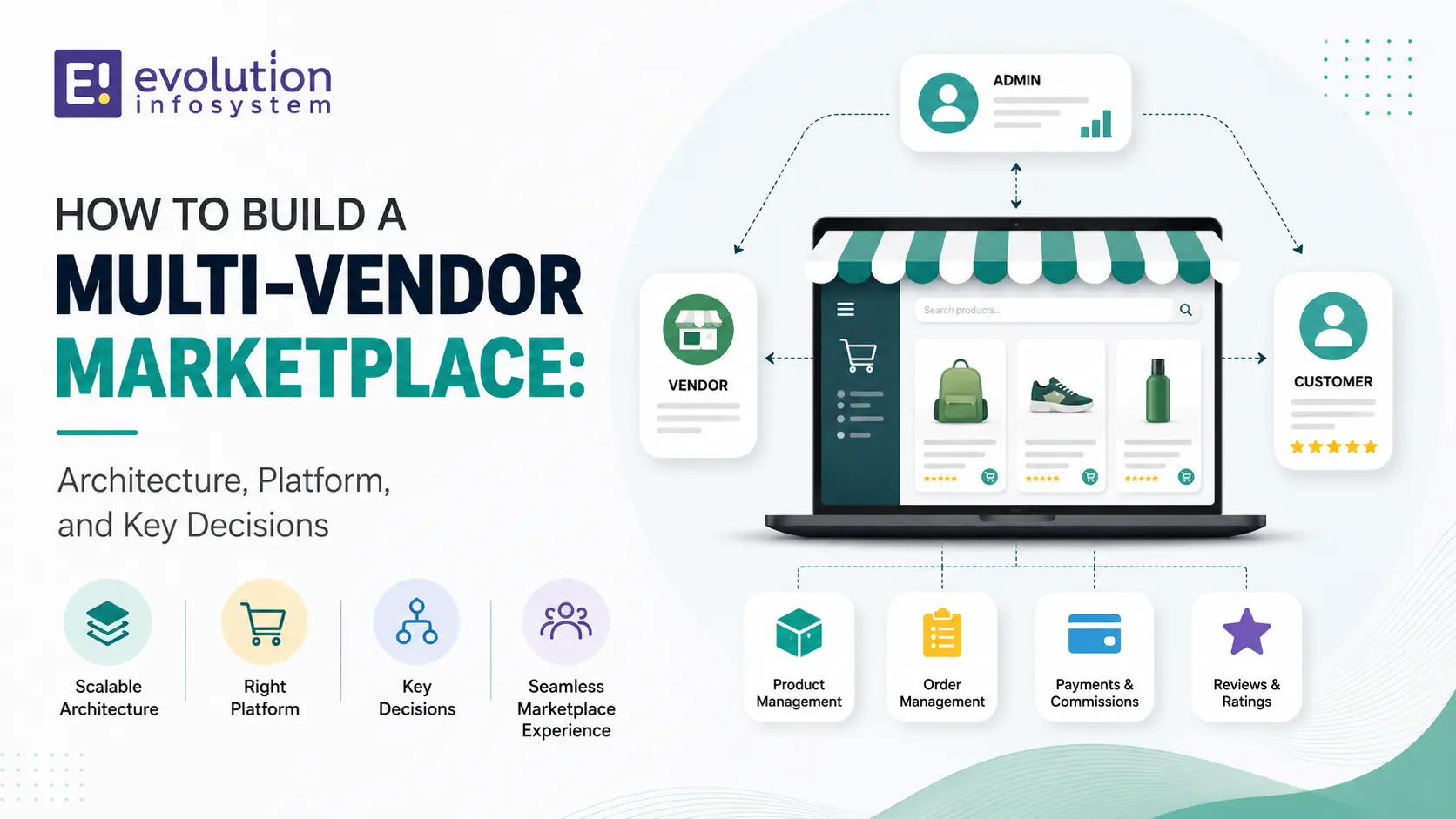
A multi-vendor marketplace is not a large e-commerce store. It’s a fundamentally different product – one where you’re building infrastructure for other businesses to sell through, not a store where you sell your own products. The complexity is categorically higher, the failure modes are different, and the decisions that determine success happen before a single product is listed.
Amazon, Etsy, Airbnb, and Uber are all marketplaces. So is the B2B procurement platform your client is asking you to build and the niche services directory a startup wants to launch. The mechanics are the same. The scale is different.
This guide covers what it takes to build a multi-vendor marketplace correctly – the architecture, the platform decision, the payment infrastructure, and the operational decisions that most guides skip past.
What Makes a Marketplace Different from a Standard E-commerce Store
In a standard e-commerce store, you have two parties: the store owner and the buyer. You control the product catalogue, the pricing, the fulfilment, and the customer relationship entirely.
In a multi-vendor marketplace, you have three parties: the marketplace operator (you), the vendor (the seller), and the buyer. You’re facilitating a transaction between two parties you don’t fully control. The products, pricing, and fulfilment are the vendor’s responsibility. Your responsibility is the platform, the trust infrastructure, and the rules that govern how vendors and buyers interact.
This three-party dynamic creates complexity that doesn’t exist in standard e-commerce:
→ Multi-party payments.
When a buyer pays, the money needs to split between your marketplace fee and the vendor’s payout. This isn’t a simple payment – it’s a payment that involves routing, fee calculation, and vendor disbursement, all with proper accounting and reporting on both sides.
→ Vendor management.
You have to onboard vendors, verify their identity, enforce quality standards, manage their catalogue within your platform, and handle disputes between vendors and buyers. This is an operational function that single-vendor stores don’t have.
→ Trust infrastructure.
Buyers are purchasing from vendors they don’t know, through a platform they’re trusting. Reviews, ratings, identity verification, buyer protection, and dispute resolution are the trust infrastructure that makes strangers willing to transact.
→ Data model complexity.
Products belong to vendors. Orders may contain products from multiple vendors. Fulfilment is per-vendor. Returns and refunds go back through vendor accounts. The data model for a marketplace is significantly more complex than for a single-vendor store.
The Platform Decision
The most important early decision is whether to build on an existing marketplace platform or build custom. This is not a simple decision. Both paths have real advantages and real failure modes.
Option 1: Marketplace-Specific Platforms
Platforms like Sharetribe, CS-Cart Multi-Vendor, Marketplacer, and Mirakl are purpose-built for marketplace operations. They provide vendor management, split payments, seller dashboards, commission management, and dispute tools out of the box.
→ When marketplace platforms win:
You need to validate market demand before investing in custom development. A Sharetribe-based marketplace can go live in weeks. If the market doesn’t respond, you haven’t invested 12 months of development.
Your marketplace model fits a standard template. Service marketplace (Sharetribe), product marketplace (CS-Cart Multi-Vendor), or enterprise supplier marketplace (Mirakl) – if your model maps to one of these, the platform covers most of your requirements without custom development.
→ When marketplace platforms fall short:
Differentiation is constrained by the platform’s flexibility ceiling. If your competitive advantage requires a UX, a workflow, or a business model the platform wasn’t designed for, you’ll spend more time working around the platform than building your marketplace.
Transaction and licence fees compound at scale. Marketplace platforms charge either per-transaction fees or licence fees (or both). At meaningful transaction volume, these costs become significant.
Option 2: Shopify with Multi-Vendor Apps
For product marketplaces, Shopify combined with multi-vendor apps (MultiVendor Marketplace by Webkul, Shipturtle, or similar) provides a faster path than custom development with more flexibility than a dedicated marketplace platform.
The limitation: multi-vendor apps on Shopify are working within Shopify’s architecture, which wasn’t designed for marketplaces. Vendor isolation, split payments, and vendor-specific fulfilment all require workarounds. For simple marketplace models, this works. For complex ones, the workarounds accumulate into a maintenance burden.
Option 3: Custom Marketplace Development
Custom development gives you complete control over architecture, UX, business model, and vendor experience. It’s the right choice when your marketplace model is differentiated, when platform constraints would significantly limit your competitive advantage, or when you’re operating at a scale where platform fees are material.
The trade-offs: longer time to market, higher initial development investment, and full ownership of the maintenance and evolution of the platform. These are acceptable trade-offs when the business case justifies them. They’re not acceptable for a first-version market validation.
The Architecture of a Multi-Vendor Marketplace
Whether you build custom or heavily extend a platform, understanding the core architectural components helps you evaluate what you have and what you need.
Vendor Management System
The vendor management system handles everything related to the seller side of your marketplace:
→ Vendor onboarding.
Application flow, identity verification (KYC – Know Your Customer), business verification, bank account collection, and terms acceptance. The onboarding process determines the quality and trust level of your vendor base. Weak onboarding produces a marketplace full of unvetted vendors. Overly complex onboarding drives good vendors away.
→ Vendor dashboard.
The interface vendors use to manage their products, track their orders, view their earnings, manage their inventory, and respond to customer enquiries. A poor vendor dashboard is one of the most common reasons vendors abandon a marketplace for a competitor.
→ Commission management.
How your marketplace fee is calculated – flat percentage, tiered by volume, category-specific, promotional – and how it applies to each transaction. Commission rules need to be flexible enough to support your go-to-market strategy (lower commissions for early vendors, category-specific rates, promotional commission reductions) without becoming so complex they’re impossible to audit.
Product and Catalogue Management
In a marketplace, products belong to vendors, not to the platform. The catalogue architecture needs to:
- Attribute products to their vendor throughout the entire commerce flow
- Support vendor-specific product data (vendor SKU, vendor price, vendor stock level) alongside marketplace-level display
- Handle multiple vendors selling the same product (if your model allows it) with appropriate deduplication or comparison logic
- Allow marketplace administrators to review, approve, or reject vendor product listings
Order Management
A marketplace order is more complex than a standard e-commerce order. A single buyer order may contain products from multiple vendors, each with different fulfilment timelines, different tracking numbers, and different return policies. The order management system needs to:
- Split a single buyer order into per-vendor sub-orders
- Track fulfilment status independently per vendor
- Handle partial fulfilment (one vendor ships, another is delayed)
- Process returns and refunds back through the correct vendor account
- Maintain a unified buyer view of their order while routing vendor-specific information to the right seller
Payments Infrastructure – The Most Critical Component
Multi-party payments are where most custom marketplace builds underestimate complexity. A buyer pays £200. £180 goes to the vendor. £20 is your commission. This sounds simple. It is not simple, for regulatory reasons that have real consequences if ignored.
The marketplace money flow options:
Option 1: Aggregated model (your marketplace receives full payment, then pays out).
Your marketplace collects the buyer’s full payment into your account, takes your commission, and pays the vendor. Simpler from a buyer experience perspective. Complicated from a regulatory perspective – in many jurisdictions, holding customer funds and distributing them to third parties requires a payment institution licence or e-money licence.
Option 2: Split payment at point of transaction.
Payment platforms like Stripe Connect, Adyen Marketplace, and PayPal Marketplace handle the split at the point of payment. The buyer pays, the platform automatically routes the vendor’s share to their connected account and your commission to your account. No intermediate fund holding. Regulatory risk is managed by the payment platform.
Stripe Connect is the dominant choice for most custom marketplace builds. It handles vendor onboarding (including identity verification for KYC), split payments, vendor payouts (daily, weekly, or on-demand), refund processing, and marketplace-level reporting. The implementation complexity is real – properly integrating Stripe Connect requires careful design – but it’s significantly lower than building the equivalent infrastructure from scratch.
Trust and Safety Infrastructure
→ Reviews and ratings.
Two-sided in a marketplace – buyers rate vendors, vendors can rate buyers (relevant for service and rental marketplaces where the buyer’s behaviour matters to the vendor). Review authenticity (only customers who completed a transaction can review) is a non-negotiable requirement.
→ Dispute resolution.
A clearly defined process for handling disputes between buyers and vendors, with defined timelines, escalation paths, and resolution options (refund, partial refund, replacement). The marketplace operator adjudicates disputes. No marketplace survives without a credible dispute resolution process.
→ Fraud prevention.
Marketplaces are targets for fraudulent vendors (listing products they don’t have, collecting payment, and disappearing) and fraudulent buyers (chargebacks after receiving goods). Stripe’s Radar fraud detection, combined with vendor verification and buyer behaviour monitoring, is the standard approach.
The Chicken-and-Egg Problem Every New Marketplace Faces
A marketplace with no vendors has nothing to offer buyers. A marketplace with no buyers has nothing to offer vendors. Every new marketplace faces this problem and has to solve it before organic network effects can take over.
The strategies that work:
→ Launch supply-first.
Recruit vendors before opening to buyers. Offer favourable early terms – zero commission for the first three months, featured placement, dedicated support. Build inventory depth in your highest-demand categories before your first buyer arrives.
→ Start narrow.
Launch in one city, one product category, or one vertical rather than trying to cover everything immediately. Density within a narrow scope creates a better experience than thin coverage across a broad one.
→ Manual facilitation.
In the earliest stage, manually broker matches between supply and demand. This isn’t scalable, but it validates that buyers and vendors actually want to transact on your platform before investing in automating the process.
Frequently Asked Questions (FAQs)
What is the difference between a marketplace and a standard e-commerce store?
A standard e-commerce store sells products owned by the store. A multi-vendor marketplace facilitates transactions between third-party vendors and buyers. The marketplace operator doesn’t own the products – they provide the platform, the trust infrastructure, and the payment routing. The operational complexity is significantly higher.
How long does it take to build a multi-vendor marketplace?
A marketplace built on a platform like Sharetribe can launch in 4–8 weeks for a basic implementation. A custom marketplace with full vendor management, split payments via Stripe Connect, order management, and trust infrastructure typically takes 4–8 months. The primary variables are custom features, payment integration complexity, and vendor management requirements.
What payment solution should I use for a marketplace?
Stripe Connect is the dominant choice for most marketplace builds. It handles vendor onboarding, identity verification, split payments, vendor payouts, and refund processing – and it manages the regulatory complexity of handling third-party funds. Adyen Marketplace is an alternative for very high volume or enterprise requirements.
What is Stripe Connect and how does it work for marketplaces?
Stripe Connect is Stripe’s marketplace payment product. Vendors create connected Stripe accounts (either directly with Stripe or through your marketplace’s onboarding flow). When a buyer pays, Stripe automatically splits the payment – routing the vendor’s portion to their connected account and your commission to your platform account – with no intermediate fund holding.
Should I build a custom marketplace or use a platform like Sharetribe?
Use Sharetribe (or a similar platform) for market validation, simple models, or when time to market is the priority. Build custom when your marketplace model requires differentiation the platform can’t support, when you’re operating at a scale where platform fees are significant, or when vendor and buyer experience requirements exceed what the platform can deliver.
At Evolution Infosystem, we build multi-vendor marketplace platforms on custom architecture, Shopify Plus with multi-vendor extensions, and purpose-built marketplace frameworks. We design the payment infrastructure, vendor management systems, and trust architecture that make marketplaces work at scale. If you’re scoping a marketplace build, let’s talk about your model and what it requires.