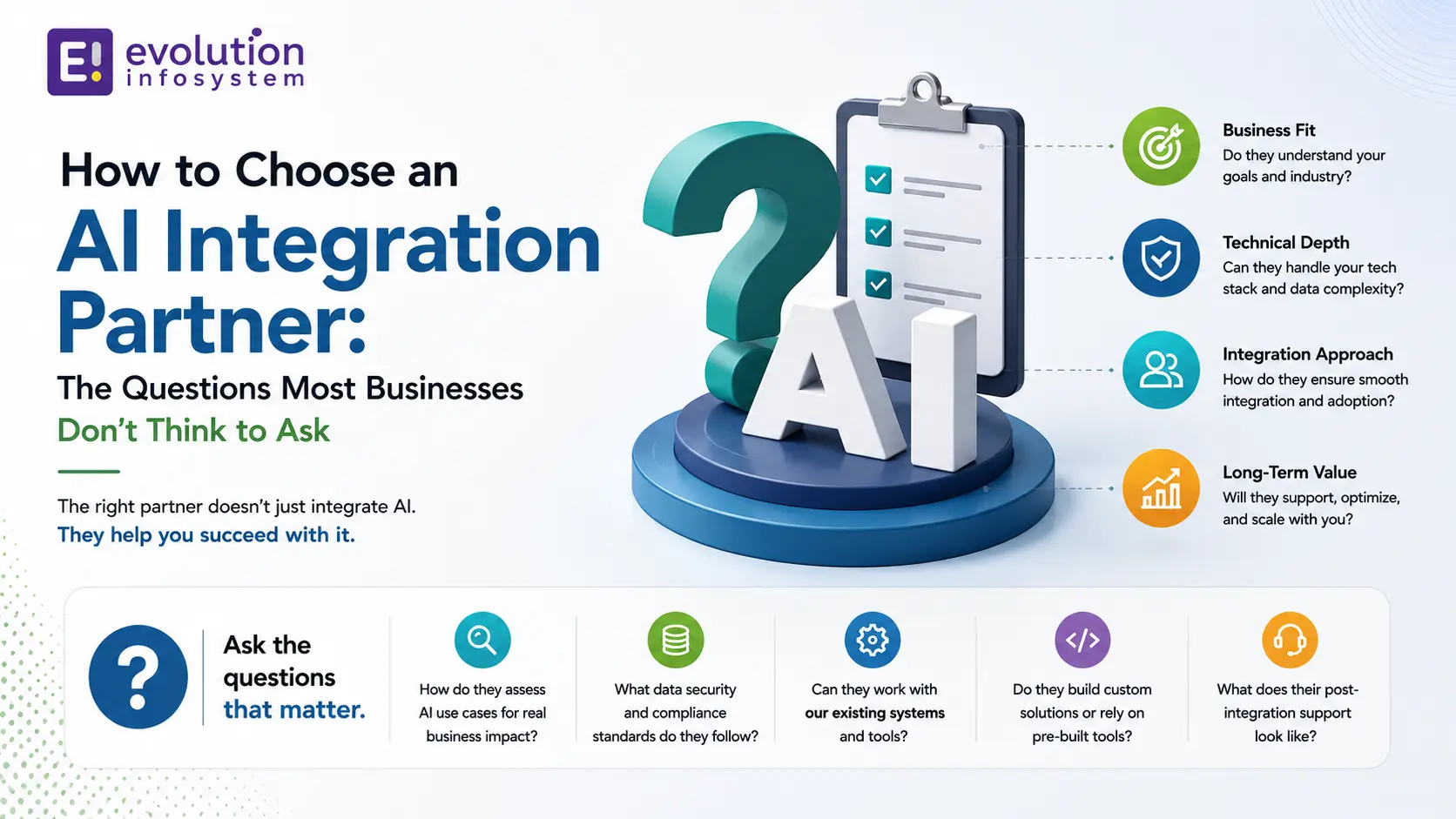
How to Choose an AI Integration Partner: The Questions Most Businesses Don't Think to Ask
Every software company claims AI capability right now. It’s the most overused phrase in the industry. “AI-powered.” “AI-driven.” “AI-native.” Most of it is positioning, not capability.
The problem is that AI integration is not like other software work. The margin for error is higher. The decisions made early have longer-lasting consequences. And the gap between a team that has shipped production AI systems and one that hasn’t is enormous. It’s not visible on a website or in a sales call. It shows up six months into a project when things break in ways nobody anticipated.
Choosing the wrong AI integration partner doesn’t just waste time. It produces AI features that erode user trust, architectures that are expensive to fix, and timelines that slip while competitors ship. Here’s how to make the right call.
Why This Decision Is Harder Than Hiring a Regular Dev Partner
When you hire a software development company to build a web application, the fundamentals are well understood. The technology is mature. Best practices are documented. You can evaluate quality by looking at code, reviewing architecture, and speaking to references about delivery reliability.
AI integration sits at the frontier of what’s currently possible. Best practices are still forming. The technology changes meaningfully every few months. The problems that matter most, retrieval quality in RAG systems, prompt reliability under edge cases, output consistency at scale, and agent behaviour in unexpected situations, are not visible in demos. They only surface in production.
This means the standard vendor evaluation playbook is insufficient. Asking for a portfolio and speaking to references is necessary but not enough. You need to go deeper.
The Questions That Reveal Real AI Capability
“What AI features have you shipped to production, and what broke?”
The first part of this question is standard. The second part is where the real signal is. Every team that has operated production AI systems has failure stories. Prompts that degraded when the model updated. Retrieval pipelines that returned irrelevant results under certain query patterns. Agents that looped unexpectedly. Output validation that caught hallucinations too late.
Teams with genuine production experience have specific, detailed answers about what went wrong and what they changed. Teams without it give you confidence and vagueness. Confidence and vagueness from a vendor is a red flag, not reassurance.
“How do you handle prompt versioning and regression testing?”
Prompts change. Models update. What worked last month may not work next month. A production AI system needs a process for managing prompt changes without breaking existing behaviour, testing changes against a representative sample of real inputs before deploying, and monitoring output quality over time.
A team that doesn’t have a clear, specific answer to this question has not operated a production LLM integration long enough to have encountered these problems. That’s a significant risk.
“Walk me through your eval infrastructure for AI outputs.”
Before shipping an AI feature, you need a way to measure whether it’s working. This means an evaluation dataset of representative inputs with expected outputs, automated scoring (either rule-based for structured outputs or LLM-as-a-judge for generation tasks), and a process for running regression tests when anything changes.
Teams that skip eval infrastructure discover problems in production. The cost of fixing a broken AI feature that’s already in users’ hands is significantly higher than catching it in testing. An experienced AI integration partner treats eval as a non-negotiable part of the build, not an optional extra.
“How do you approach RAG retrieval quality?”
Retrieval quality is the hardest part of RAG to get right. A RAG pipeline that retrieves the wrong context produces confidently wrong outputs. The chunking strategy, the embedding model, the retrieval ranking, the context window management all affect quality in ways that aren’t obvious until you’re testing against real queries.
An experienced team has strong opinions about retrieval quality. They’ve made mistakes, adjusted their approach, and developed views on what works for different use cases. A team that gives you a generic answer about vector databases and similarity search probably hasn’t pushed a RAG system hard enough to find its failure modes.
“What’s your process when hallucination is a real risk?”
For some AI use cases, hallucination is an inconvenience. For others, it’s a serious reliability or liability problem. Legal content, medical information, financial data, factual citations. How a team handles hallucination risk tells you a great deal about their understanding of where LLMs actually fail.
The answer should involve retrieval grounding (RAG), output validation against source documents, confidence thresholds, and human-in-the-loop checkpoints for high-stakes outputs. A team that says “the model is really accurate now” has not thought seriously about this.
“How do you stay current?”
The AI landscape changes faster than any other area of software development. Models improve, sometimes dramatically, on a quarterly basis. New frameworks emerge. Best practices evolve. A team that was doing excellent work six months ago needs to be actively tracking developments to be doing excellent work today.
Ask specifically:
What changed in your approach in the last six months based on what you learned?
What tools or frameworks did you stop using and why?
A team actively operating in this space has clear answers. A team that dips into AI occasionally doesn’t.
Red Flags to Walk Away From
→ Guaranteed outcomes on AI output quality.
Nobody can guarantee LLM output quality absolutely. Anyone who does is either oversimplifying or hasn’t thought seriously about edge cases.
→ No mention of evaluation or testing infrastructure.
If a team’s proposal or sales conversation doesn’t include how they’ll measure and validate output quality, they’re planning to skip it. That’s how you end up with AI features that work in demos and break in production.
→ “We use the latest AI tools.”
This tells you nothing. Using Cursor or GitHub Copilot in development is not AI product development experience. Ask for production examples, not tool familiarity.
→ Vague answers about architecture decisions.
An experienced AI team has strong views on why they’d choose one approach over another for a given use case. Vagueness about architectural decisions suggests the decisions are being made reactively rather than from experience.
→ No pushback on your requirements.
A team that agrees with everything you say about your AI requirements isn’t bringing expertise to the table. The most valuable thing an experienced AI partner does early in an engagement is challenge your assumptions about what you need to build and how.
→ Emphasis on model selection over system design.
Choosing which LLM to use is not the hard part of AI product development. System design, data architecture, evaluation infrastructure, and reliability engineering are the hard parts. A team that leads with “we use the best models” is prioritising what’s easy to talk about over what actually matters.
What Good Looks Like
A genuinely capable AI integration partner:
Asks hard questions about your data before talking about technology. The quality and accessibility of your data determines what’s possible. A team that doesn’t engage seriously with your data situation early is skipping the most important constraint.
Tells you what you don’t need to build. Over-engineering is the most common mistake in AI product development. An experienced partner talks you out of complexity as often as they talk you into it.
Has a specific evaluation plan before the build starts. Not “we’ll test it” but “here’s how we’ll measure output quality, here’s the eval dataset structure, here’s how we’ll run regression tests.”
Talks about failure modes, not just capabilities. The AI features that erode user trust are the ones where failure is unexpected. A partner who has thought seriously about where things go wrong is building in reliability from the start.
Gives you a realistic timeline, not an optimistic one. AI features consistently take longer than teams expect the first time. A partner who has shipped them before gives you timelines based on what actually happened, not what the demo suggested.
At Evolution Infosystem, we’ve shipped AI integrations into production systems across industries. We have the failure stories, the lessons learned, and the evaluation infrastructure to show for it. When you talk to us, we’ll tell you what we would have done differently on past projects, what we think you probably don’t need to build, and what the real risks in your use case are. Start that conversation here.
Frequently Asked Questions (FAQs)
How do I evaluate an AI integration partner’s real capability?
Ask for specific production examples and what broke. Ask about their prompt versioning and regression testing process. Ask about their eval infrastructure. Ask how they handle hallucination risk. Teams with genuine production AI experience have specific, detailed answers to all of these.
What are the biggest red flags when choosing an AI development partner?
Guaranteed outcomes on AI quality, no mention of evaluation or testing infrastructure, vague architectural answers, no pushback on your requirements, and emphasis on which models they use rather than how they design systems.
What questions should I ask an AI development partner before hiring them?
Ask what AI features they’ve shipped to production and what went wrong. Ask about their prompt versioning process. Ask them to walk you through their RAG retrieval quality approach. Ask what their eval infrastructure looks like. Ask how they stay current with a rapidly evolving field.
Is it better to build AI in-house or use an external AI integration partner?
For most businesses, an external AI integration partner gets you to production faster and with better quality than building in-house, especially if you’re early in your AI journey. Build in-house when AI is your core product differentiator, and you have the runway to hire and develop a strong internal team.