IoT Development: What's Actually Being Built and Why It Matters for Your Business
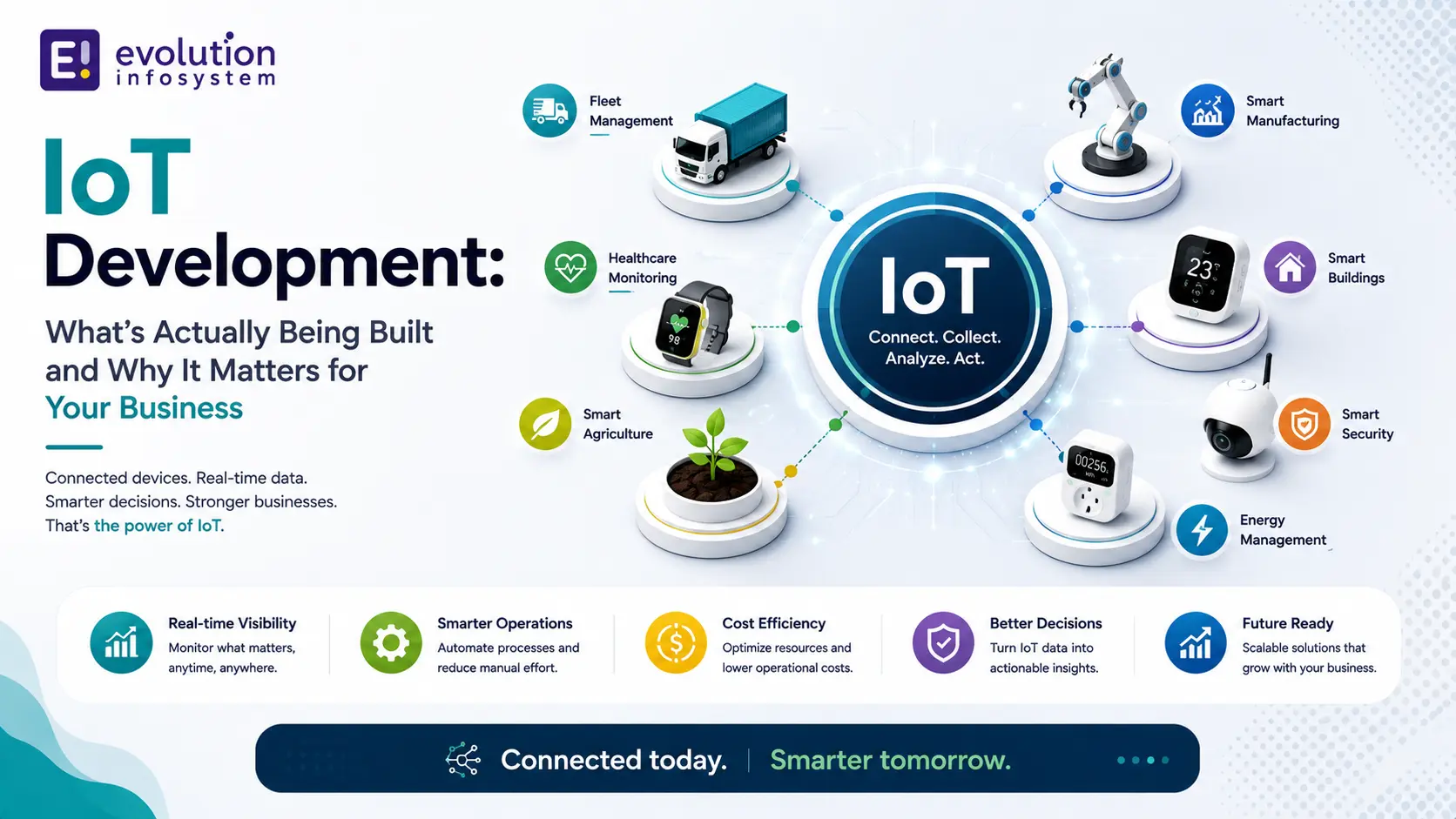
IoT had a hype cycle that went roughly like this: enormous excitement, inflated expectations, a wave of failed deployments, and then a period where the industry quietly figured out what actually worked. That period is over. IoT is now a mature enough technology that the deployments producing real business value are well understood, and the mistakes that led to failed ones are well documented.
The question for most businesses is no longer “is IoT real.” It’s “does IoT solve my specific problem, and if so, what does building it correctly actually look like.”
Here’s the honest answer to both.
What Businesses Are Actually Building with IoT
The use cases producing consistent, measurable value in IoT deployments today fall into a handful of well-defined categories.
→ Predictive maintenance.
Sensors on industrial equipment monitor vibration, temperature, pressure, and electrical current. Machine learning models trained on historical failure data identify anomaly patterns that precede equipment failure, often days or weeks before the failure would have been detected manually. The business case is direct: unplanned downtime costs more than planned maintenance. Manufacturers and logistics operators using predictive maintenance report 20-30% reductions in maintenance costs and significantly fewer unplanned production stoppages.
→ Asset tracking and visibility.
GPS and RFID-enabled tracking of physical assets, vehicles, inventory, and equipment. Real-time location data, utilisation metrics, and condition monitoring for assets that move through complex supply chains or are deployed across geographically distributed operations. The value is operational: less time searching for assets, better utilisation rates, faster response to exceptions.
→ Environmental and condition monitoring.
Temperature, humidity, air quality, energy consumption, and structural condition monitoring in buildings, cold chains, data centres, and agricultural operations. The use case is often regulatory (cold chain compliance for pharmaceuticals and food), operational (energy efficiency), or safety-critical (structural monitoring of bridges and buildings).
→ Smart energy management.
Real-time monitoring of energy consumption at the device, floor, building, and campus level. Automated load balancing, demand response, and integration with renewable energy sources. Commercial real estate and manufacturing operations using smart energy management consistently report 15-25% reductions in energy costs.
→ Connected product intelligence.
Products that report their own usage data back to the manufacturer. Warranty claim validation, feature usage analytics, proactive support intervention before customers contact you, and usage-based service models. The intelligence your connected product provides about how customers actually use it is more valuable to product development decisions than any amount of survey data.
→ Industrial process automation.
Sensors and actuators that monitor and adjust physical processes in real time, replacing manual adjustment and enabling tighter process control. In manufacturing, this means tighter tolerances, less waste, and faster identification of process drift. In agriculture, it means precise irrigation and fertilisation based on actual soil and weather conditions rather than schedules.
The Architecture Decision Every IoT Project Gets Wrong First
Most failed IoT deployments fail for the same reason: everything is sent to the cloud for processing, and the architecture can’t handle the volume, the latency, or the connectivity requirements that real-world deployment creates.
This is the cloud-first trap. It works in a proof of concept with ten devices and a reliable internet connection. It breaks when you have ten thousand devices, intermittent connectivity, and latency requirements measured in milliseconds rather than seconds.
The right architecture for most IoT deployments in production is a three-tier model:
→ Edge layer.
Computation happens on the device or at a local gateway, close to where the data is generated. Time-sensitive decisions (equipment shutoff when a safety threshold is exceeded, real-time process adjustments) happen at the edge without a cloud round-trip. Raw data is filtered, aggregated, and compressed before transmission. Devices continue to function when connectivity is interrupted.
→ Fog/gateway layer.
Local servers or gateways aggregate data from multiple devices, run more computationally intensive models than can run on the device itself, store data temporarily during connectivity interruptions, and manage the connection between the edge and the cloud.
→ Cloud layer.
Long-term data storage, complex analytics, cross-site aggregation, ML model training, dashboards, and integration with enterprise systems (ERP, CMMS, CRM). The cloud receives processed, filtered data, not every raw sensor reading from every device.
Getting this architecture right at the start matters because retrofitting it is expensive. An IoT system architected cloud-first that needs to move processing to the edge requires rethinking device hardware, firmware, and data pipeline simultaneously.
The Connectivity Problem Nobody Talks About Enough
Connectivity is the most underestimated challenge in IoT deployment. The connectivity that works in a lab or office environment is often not what’s available or appropriate in the actual deployment environment.
Industrial facilities have RF interference, metal shielding, and physical layouts that make Wi-Fi unreliable at scale. Agricultural deployments span kilometres where cellular coverage is inconsistent. Cold storage environments have physical barriers that degrade the signal. Underground infrastructure has no connectivity at all.
The connectivity technology selection needs to match the deployment environment, power constraints, and data requirements simultaneously. Wi-Fi, cellular (4G/5G), LoRaWAN, NB-IoT, Zigbee, Z-Wave, Bluetooth mesh, and private LTE all have different trade-offs across range, bandwidth, power consumption, cost, and reliability. There is no universal right answer. The right answer depends on your specific deployment context.
Designing for connectivity failure is equally important. Devices need local storage for data buffering when connectivity is lost, intelligent retry and synchronisation mechanisms when connectivity restores, and the ability to make critical local decisions without cloud connectivity.
Security: The Dimension Most IoT Projects Underinvest In 2026
IoT security failures are catastrophic in a way that web application security failures often aren’t. A compromised IoT device in an industrial facility is not just a data breach. It’s potential physical harm, process disruption, or infrastructure sabotage.
The attack surface in an IoT deployment is large: devices themselves, the connectivity layer, gateways, APIs, cloud infrastructure, and the enterprise systems IoT data feeds into. Every point in that chain is a potential entry point.
The security requirements that matter in production IoT:
→ Device identity and authentication.
Each device needs a unique, cryptographically secure identity. Shared credentials across a device fleet mean that compromising one device compromises all of them.
→ Encrypted communication.
All data in transit between devices, gateways, and cloud must be encrypted. This sounds obvious. It is consistently skipped or implemented inadequately in the pressure to hit deployment timelines.
→ Secure boot and firmware verification.
Devices should verify the integrity of their firmware before execution and refuse to run unsigned or tampered code. This prevents malicious firmware installation on physical devices.
→ Over-the-air update capability.
Security vulnerabilities will be discovered after deployment. The ability to update device firmware remotely is not optional for any long-lived IoT deployment. Building it in from the start is significantly cheaper than retrofitting it.
→ Network segmentation.
IoT devices should be on isolated network segments, unable to access enterprise systems directly. Lateral movement from a compromised IoT device to enterprise infrastructure is a well-documented attack pattern.
How to Tell If IoT Is Actually the Right Solution
IoT is often proposed for problems that have cheaper, simpler solutions. Before committing to an IoT deployment, validate that the use case meets these criteria:
→ The data that drives the decision is physical.
IoT sensors measure physical phenomena in the real world. If the data you need already exists in digital systems, IoT is not the right tool.
→ The decision frequency justifies automation.
IoT produces continuous or high-frequency data streams. If the decision you’re trying to improve happens weekly rather than continuously, you probably don’t need real-time sensor data.
→ The latency requirements justify edge processing.
If your decisions can tolerate minutes or hours of latency, you may not need IoT at all. Batch data collection and manual analysis might achieve the same result.
→ The environment supports the connectivity requirements.
An IoT deployment that assumes connectivity it doesn’t have is a deployment that will fail. Validate connectivity in the actual deployment environment before committing to an architecture that depends on it.
→ The ROI is clear before deployment.
IoT deployments are not cheap. Hardware, connectivity, software, integration, and maintenance all have real costs. The business case needs to be specific: this sensor data enables this decision, which produces this measurable outcome, which justifies this investment.
Frequently Asked Questions (FAQs)
What industries benefit most from IoT development?
Manufacturing (predictive maintenance, process automation), logistics and supply chain (asset tracking, cold chain monitoring), agriculture (precision irrigation, environmental monitoring), commercial real estate (energy management, occupancy optimisation), and healthcare (patient monitoring, equipment tracking) are the industries with the most mature and well-documented IoT use cases.
What is edge computing in IoT and why does it matter?
Edge computing processes data on or near the IoT device rather than sending everything to the cloud. It reduces latency for time-sensitive decisions, reduces bandwidth and cloud costs, enables operation during connectivity interruptions, and improves security by limiting the data that leaves the physical environment.
How long does an IoT development project take?
A focused IoT proof of concept with defined scope takes 8-12 weeks. A production deployment covering device firmware, gateway software, cloud infrastructure, enterprise integration, and security hardening typically takes 4-9 months depending on the number of device types, connectivity complexity, and integration requirements.
What is the biggest reason IoT projects fail?
Architecture decisions made for the demo environment that don’t hold up in real-world deployment. Specifically: cloud-first architectures that can’t handle connectivity intermittency or latency requirements, security implementation that is insufficient for the actual threat environment, and connectivity technology choices that don’t match the physical deployment context.
At Evolution Infosystem, we build IoT systems for industrial, commercial, and agricultural applications. We design for the edge from the start, take connectivity and security seriously from day one, and tell you honestly when IoT is not the right solution for your specific problem. Let’s talk about what you’re trying to measure and decide.