MERN Stack vs. LAMP Stack: Which Should You Build Your Web App On?
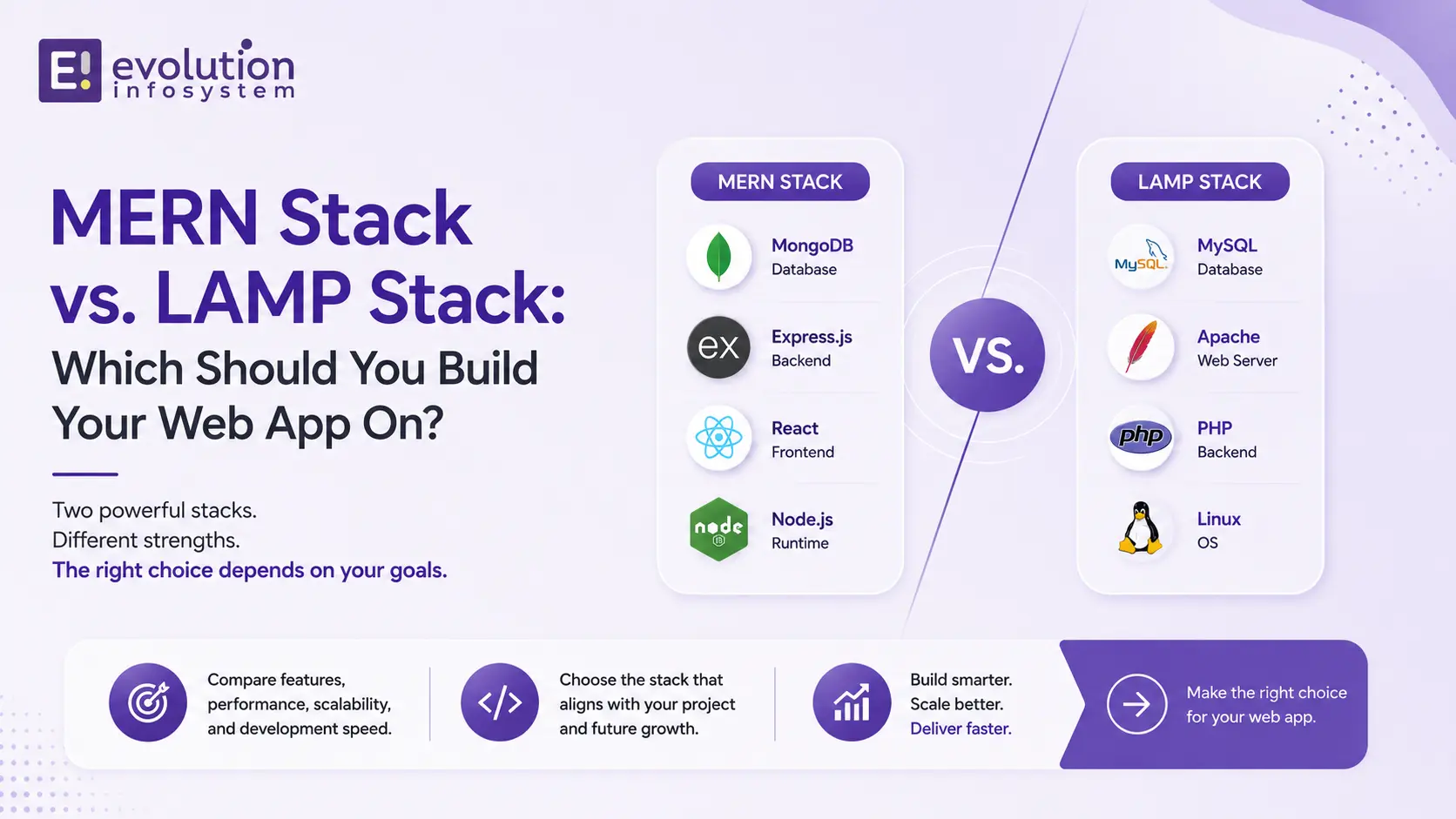
Two technology stacks dominate a significant share of web application development: MERN (MongoDB, Express, React, Node.js) and LAMP (Linux, Apache, MySQL, PHP). Both have delivered millions of production applications. Both have genuine strengths. And both get chosen for the wrong reasons more often than they should.
The MERN stack vs LAMP stack debate isn’t about which is objectively better. It’s a guide to which one is right for your specific application, your team, and your long-term requirements. The answer changes depending on all three.
What Each Stack Actually Is
MERN stack is a JavaScript-only architecture. MongoDB is the database (document-based, JSON-native). Express.js is the backend web framework running on Node.js. React is the frontend library. Node.js is the JavaScript runtime. The defining characteristic: JavaScript runs everywhere – frontend, backend, and (in the case of MongoDB) even in query logic. One language across the entire application.
LAMP stack is the combination of Linux (operating system), Apache (web server), MySQL (relational database), and PHP (server-side scripting language). It’s been the backbone of web development since the late 1990s. WordPress, Drupal, Facebook (originally), Wikipedia, and an enormous proportion of the world’s web applications were built on LAMP or its variants (LEMP with Nginx, or with Laravel on top of PHP).
MERN Stack: Where It Wins
Real-Time Applications
Node.js is event-driven and non-blocking. Unlike traditional PHP, which handles each request in a separate thread, Node.js can handle thousands of concurrent connections on a single thread without blocking. This makes MERN the natural choice for:
- Real-time chat applications
- Live dashboards and analytics feeds
- Collaborative editing tools (think Google Docs-style features)
- Notification systems
- Streaming data applications
If your application requires any persistent connection between client and server – WebSockets, Server-Sent Events – Node.js handles this far more elegantly than PHP.
Single-Page Applications (SPAs)
React is purpose-built for interactive, dynamic user interfaces. If your web application behaves more like a desktop application than a traditional website – rich interactions, client-side routing, dynamic content loading without page refreshes – MERN with React is the right foundation.
JavaScript Team Alignment
If your development team already works in JavaScript – either because they come from a frontend background or because your existing codebase is JavaScript-heavy – MERN eliminates the context switch between frontend and backend. One language, one set of conventions, shared utility code. The productivity gain is real for teams already in the JavaScript ecosystem.
Flexible, Rapidly Changing Data Models
MongoDB’s document model (JSON-like documents instead of relational tables) suits applications where the data structure evolves quickly. Early-stage products where the schema changes sprint to sprint benefit from MongoDB’s flexibility. You’re not running migrations every time your data model changes.
LAMP Stack: Where It Wins
Relational Data with Complex Queries
MySQL (and its variants like MariaDB) is a mature, battle-tested relational database. If your application has complex data relationships, requires joins across multiple tables, depends on transactional integrity (ACID compliance), or runs complex analytical queries – a relational database is the stronger foundation.
MongoDB’s document model trades relational integrity for flexibility. For applications where data relationships are well-defined and data integrity matters (financial systems, e-commerce, ERP, healthcare), MySQL’s relational model is the right choice.
PHP and Laravel’s Mature Ecosystem
PHP has been the web’s server-side language for 25 years. The ecosystem is enormous. Laravel, PHP’s dominant modern framework, provides authentication, routing, ORM, queuing, scheduling, and a full application architecture out of the box. The volume of production-tested Laravel packages, the size of the Laravel community, and the number of available Laravel developers globally make it a remarkably low-risk choice.
For applications that need to move fast and leverage a rich ecosystem of pre-built components, Laravel on LAMP is often faster to production than MERN.
Content-Heavy and CMS-Backed Applications
WordPress, Drupal, and Joomla all run on LAMP. If your application is adjacent to or integrated with any of these – a custom theme, a plugin, a headless WordPress backend – LAMP is the natural fit. The ecosystem integration is immediate.
Traditional Web Applications
Multi-page web applications where the server renders HTML and sends it to the browser – traditional websites, admin portals, content management systems, form-heavy business applications – are well-served by PHP’s synchronous, request-response model. The simplicity of PHP’s execution model (one request, one response, done) is a genuine advantage for applications that don’t need real-time capabilities.
Side-by-Side Comparison
| Factor | MERN Stack | LAMP Stack |
|---|---|---|
| Language | JavaScript everywhere | PHP (backend) + JavaScript (frontend) |
| Database | MongoDB (document) | MySQL (relational) |
| Real-time capability | Excellent (Node.js) | Limited (requires additional tooling) |
| Data integrity | Flexible (less strict) | Strong (ACID, relational constraints) |
| Learning curve | Medium | Lower (PHP is forgiving) |
| Ecosystem maturity | Growing, modern | Very mature, vast |
| Developer availability | High | Very high |
| Performance (high concurrency) | Excellent | Good with caching |
| CMS integration | Requires custom work | Native (WordPress, Drupal, Joomla) |
| Best for | SPAs, real-time, APIs | Traditional web apps, content, e-commerce |
The 5 Questions That Decide It
1. Does your application need real-time features?
Yes → MERN. Node.js handles real-time connections natively. PHP does not.
2. Is your data model relational with complex join queries?
Yes → LAMP with MySQL. A document database is the wrong foundation for highly relational data.
3. Is your frontend primarily an SPA or a traditional multi-page site?
SPA → MERN. Multi-page, server-rendered → LAMP is simpler and equally capable.
4. What does your development team know?
JavaScript-first team → MERN. PHP-experienced team → LAMP. Choosing the unfamiliar stack costs you delivery velocity.
5. Are you integrating with WordPress, WooCommerce, or another PHP CMS?
Yes → LAMP. The integration overhead of connecting MERN to a PHP CMS is real and usually unjustified.
What About MEAN, MEVN, and Other Variants?
MEAN (MongoDB, Express, Angular, Node.js) replaces React with Angular. The backend is identical to MERN – the only difference is the frontend framework. Angular is more opinionated and structured than React; it suits larger teams with standardised patterns. React suits smaller, faster-moving teams. The MERN vs. MEAN decision is almost entirely about React vs. Angular.
LEMP (Linux, Nginx, MySQL, PHP) replaces Apache with Nginx. For high-traffic applications, Nginx’s event-driven architecture performs better than Apache’s process-based model under heavy concurrent load. LEMP is simply a more performance-tuned version of LAMP.
A Note on Full-Stack JavaScript
One argument for MERN that’s worth addressing directly: “we can hire one developer who does everything.” This is technically true – a JavaScript developer can write both React and Node.js. In practice, front-end specialists and back-end specialists exist on both stacks. The full-stack JavaScript developer who is equally strong at React and Node.js at a senior level is less common than the theoretical argument suggests. Don’t base your architecture decision on a staffing assumption.
At Evolution Infosystem, we build on both – MERN stack for real-time, SPA-centric applications and LAMP stack for content-heavy, relational, and CMS-integrated applications. We’ll recommend the right one for your requirements and deliver on it. Let’s discuss your web application.
Frequently Asked Questions
Is MERN stack better than LAMP stack?
Neither is universally better. MERN is better for real-time applications, single-page applications, and JavaScript-first teams. LAMP is better for relational data, content management, and applications where PHP’s mature ecosystem reduces development time. The right choice depends on your application type, data model, and team expertise.
Is PHP still relevant when Node.js exists?
Yes. PHP powers over 77% of all server-side websites. Laravel is one of the most productive web frameworks available. The “PHP is dead” narrative has been circulating since 2010 and has been wrong every year since. Node.js is better for specific use cases (real-time, high concurrency). PHP remains the stronger choice for traditional web applications and the CMS ecosystem.
Can I use MySQL with Node.js?
Yes. Node.js works with MySQL (via libraries like mysql2 or Sequelize ORM). The MERN stack’s use of MongoDB is conventional, not mandatory. If your application needs a relational database but benefits from Node.js’s real-time capabilities, using Node.js with MySQL is a legitimate architecture – often called the MEAN stack with MySQL substitution.
Which stack is easier to find developers for?
Both have large developer communities. PHP/Laravel developers are marginally more widely available globally due to the technology’s longer history. React and Node.js developers are equally available in most markets. Neither stack creates a significant hiring bottleneck.
Which stack is better for startups?
MERN for startups building SPAs, real-time products, or API-first architectures. LAMP (particularly Laravel) for startups that need to move fast with a rich ecosystem of pre-built components, or for products adjacent to the WordPress/WooCommerce ecosystem. Both are viable startup stacks – the decision should be driven by the product type.