.NET Core vs Java: Which Is Better for Enterprise Apps?
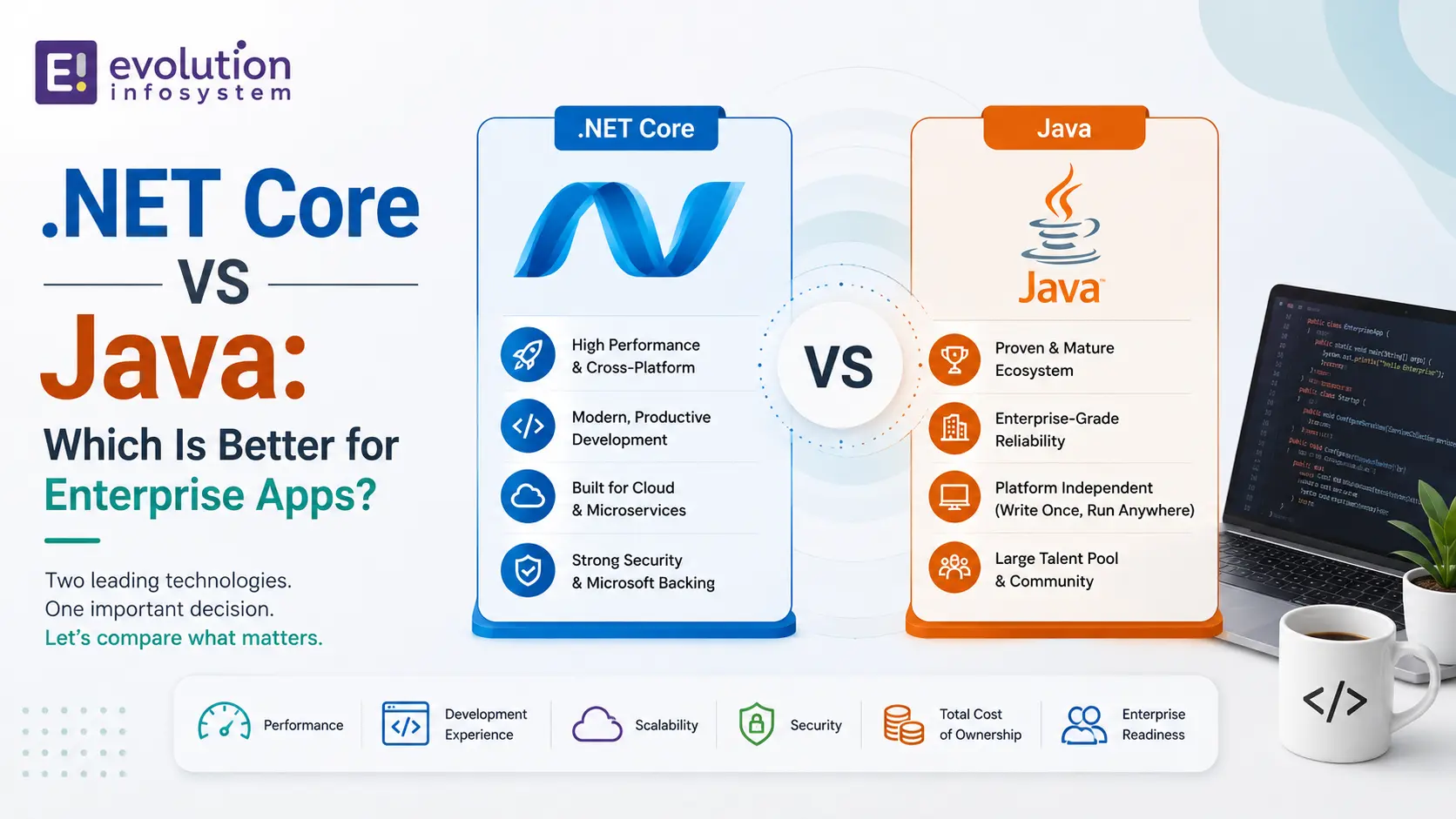
Most comparisons of .NET Core vs Java for enterprise end the same way: a long list of features followed by “it depends on your specific situation,” leaving you exactly where you started before you began reading. This guide is built to actually resolve that ambiguity. Rather than another neutral feature list, we give you a genuine decision framework for evaluating .NET Core vs Java for enterprise projects, grounded in your existing infrastructure, team skills, and workload characteristics, so you finish this article with an actual answer rather than a longer list of considerations to weigh on your own.
Both platforms are genuinely mature, enterprise-proven technologies powering a significant share of Fortune 500 backend systems today, and neither is going away. The real question CTOs and engineering leads need answered is not which platform is objectively superior in the abstract, but which specific platform fits your specific cloud strategy, talent pool, and workload profile. This guide walks through .NET Core vs Java for enterprise decision-making the way an experienced architect actually approaches it, not the way a generic listicle does.
Key Terms Worth Knowing
Glossary for This Guide
A short glossary makes the more technical sections of this .NET Core vs Java for enterprise comparison easier to follow. CLR (Common Language Runtime) is .NET’s managed execution environment, handling memory management and garbage collection. JVM (Java Virtual Machine) is Java’s equivalent managed runtime, providing the platform independence Java has offered since its earliest releases.
Native AOT is .NET’s ahead-of-time compilation technology, producing native executables with faster startup and lower memory usage than traditional just-in-time compilation. GraalVM is Java’s comparable native compilation technology, closing much of the historical startup-time gap with .NET in container and serverless contexts. Virtual threads, introduced through Project Loom, are Java’s lightweight concurrency model, letting applications handle vastly more concurrent connections than traditional OS threads allow. TCO (Total Cost of Ownership) covers the full cost of a platform choice over time, including infrastructure, licensing, hiring, and maintenance, not just initial development cost.
Comparing .NET and Java at a Glance
| .NET | Java | |
|---|---|---|
| Runtime | CLR | JVM |
| Primary language | C# | Java (Kotlin, Scala also common) |
| Native compilation | Native AOT | GraalVM |
| Cloud strength | Azure-native | AWS, GCP, multi-cloud |
| Best workload fit | CPU-heavy, raw API throughput | I/O-heavy, high concurrency |
| Talent pool | Growing, smaller than Java’s | Larger, more mature |
| Strongest industries | Microsoft-ecosystem enterprises | Banking, telecom, government |
| LTS support | .NET 8 through Nov 2026 | Java 17, 21 multi-year LTS |
This table captures the highest-leverage differentiators worth weighing in any serious .NET Core vs Java for enterprise decision, though as covered throughout this guide, your own specific context should weight each row differently than a generic industry reader might.
What Existing Comparisons Get Wrong
The Problem With “It Depends” Content
Search for .NET Core vs Java for enterprise today and you will find dozens of articles covering the same surface-level ground: both are mature, both are cross-platform, both have cloud support, performance “depends on your workload.” This is not wrong, but it is also not actionable, since it leaves the reader with the same decision paralysis they started with.
This guide takes a different approach, built around a structured decision framework with specific, weighted criteria you can apply to your own organization, rather than a neutral recitation of features that treats every enterprise’s situation as identical. Understanding the platforms in the abstract matters less than understanding which specific factors should tip your decision one way or the other, and that is exactly the gap this particular resource is written to close for anyone genuinely trying to resolve a live .NET Core vs Java for enterprise decision rather than simply browse feature comparisons out of curiosity.
Why This Decision Deserves More Rigor Than It Usually Gets
A backend platform decision is one of the most expensive to reverse of any technology choice an enterprise makes, often locking in talent hiring, tooling investment, and architectural patterns for a decade or more. Given these stakes, the .NET Core vs Java for enterprise decision deserves a genuinely structured evaluation process, not a coin flip disguised as a feature comparison.
Understanding Both Platforms Today
What .NET Actually Is in 2026
Modern .NET unified the legacy Windows-only .NET Framework and the cross-platform .NET Core lineage starting with .NET 5 in 2020, and the platform now runs at .NET 9, with .NET 10 already in active development. .NET runs on the Common Language Runtime, handling memory management, garbage collection, and security enforcement, with C# as its primary language alongside F# and VB.NET.
Recent versions have focused heavily on performance, with Native AOT compilation letting applications compile directly to native code rather than relying on just-in-time compilation, meaningfully reducing startup time and memory footprint, a genuinely significant consideration in any .NET Core vs Java for enterprise conversation involving containerized or serverless deployment.
This evolution matters for how you should read any comparison content, including this one: a .NET Core vs Java for enterprise article written even three or four years ago may describe a meaningfully different, less mature version of the .NET platform than what actually exists today, since the pace of change across recent releases has been substantial.
What Java Actually Is in 2026
Java runs on the Java Virtual Machine, giving it the same fundamental “write once, run anywhere” portability it has offered since its earliest releases, now backed by decades of production hardening across every major industry. Recent LTS releases, Java 17 and Java 21, have added records, sealed classes, and virtual threads through Project Loom, a genuinely significant advancement for high-concurrency workloads that directly affects the .NET Core vs Java for enterprise performance conversation.
GraalVM offers Java its own answer to Native AOT compilation, producing native executables with faster startup and lower memory usage than the traditional JVM approach, closing what was once a meaningful gap with .NET in container and serverless-friendly deployment scenarios.
Ongoing work through Project Panama and Project Valhalla continues to modernize Java’s interoperability with native code and its memory layout efficiency respectively, both active areas of development worth monitoring for any organization planning a multi-year .NET Core vs Java for enterprise strategy rather than a purely short-term decision.
Performance: Where the Real Differences Actually Lie
CPU-Bound vs I/O-Bound Workloads
The most substantive technical difference in any honest .NET Core vs Java for enterprise performance comparison is not a universal “faster” verdict, but a workload-dependent one. .NET, and ASP.NET Core specifically, tends to show a performance edge for CPU-intensive tasks and raw web API throughput in common benchmarks.
Java, by contrast, generally performs better on I/O-heavy, high-concurrency workloads, helped considerably by mature, well-optimized libraries like Netty and, more recently, virtual threads that make handling massive concurrent connection counts significantly more efficient than the traditional thread-per-request model. Any .NET Core vs Java for enterprise decision resting primarily on performance should start by honestly characterizing your actual workload profile rather than relying on a generic benchmark that may not reflect your specific application pattern.
It is worth stressing that published benchmarks comparing these platforms vary considerably based on the specific test methodology, hardware, and application pattern used, which is exactly why relying on a single headline benchmark number to settle a .NET Core vs Java for enterprise decision is a mistake. Request or run benchmarks using a workload pattern genuinely representative of your own application, not a generic synthetic test designed to showcase one platform’s best-case scenario.
Why Architecture Usually Matters More Than Language Choice
A recurring, important caveat across genuinely rigorous .NET Core vs Java for enterprise comparisons: real-world performance depends more on system architecture, caching strategy, database design, and query efficiency than on the underlying platform choice itself. A well-architected application on either platform will outperform a poorly architected application on the other, which means performance alone is rarely sufficient grounds to decide this question in isolation from your team’s actual architectural discipline and experience.
This is one of the most consistently underweighted factors in typical .NET Core vs Java for enterprise content, since a feature comparison table cannot capture your specific team’s architectural maturity. An experienced team building on the “weaker” platform for a given workload will frequently outperform an inexperienced team building on the theoretically stronger one, simply through better caching, indexing, and query design decisions made throughout the build.
Cloud and Deployment Considerations
Azure Integration vs Multi-Cloud Flexibility
If your organization already runs on Azure, Microsoft 365, and SQL Server, .NET typically offers meaningfully lower total cost of ownership, given tight native integration across the Microsoft ecosystem, from identity management through native Azure Cognitive Services and GitHub Copilot integration for AI-assisted development.
If your infrastructure is multi-cloud or Linux-heavy, Java frequently proves more cost-effective to operate, given its long history of strong support across AWS, Google Cloud, and hybrid cloud environments, independent of any single vendor’s ecosystem. This single factor, existing cloud commitment, is one of the highest-leverage inputs into any genuine .NET Core vs Java for enterprise decision framework, often outweighing raw performance benchmarks entirely.
Calculate the actual switching cost of moving away from your current cloud commitment before treating this factor as decisive, however. An organization deeply invested in Azure identity, networking, and data services faces real migration cost and risk if choosing Java simply because of a marginal performance edge on a specific benchmark, cost that rarely shows up in a simple feature-by-feature .NET Core vs Java for enterprise comparison table.
Containers and Kubernetes
Both platforms have matured considerably in container-native deployment, supporting Docker and Kubernetes with proven, production-grade patterns. The remaining differentiator in this specific area often comes down to your team’s comfort with GraalVM’s native image build process versus .NET’s Native AOT toolchain, rather than any fundamental capability gap between the two ecosystems at this point.
Talent, Ecosystem, and Long-Term Support
Developer Availability and Hiring
Java maintains a larger, more mature global talent pool, a meaningful legacy advantage from its multi-decade head start, while .NET has closed this gap substantially in recent years, helped by Microsoft’s sustained investment in developer community, education, and tooling. Any realistic .NET Core vs Java for enterprise decision needs to weigh your specific regional hiring market, not just global averages, since talent availability varies considerably by geography and industry.
Consider running a quick, informal hiring market check specific to your location before finalizing a .NET Core vs Java for enterprise decision based purely on general industry statistics. A city or region with an unusually strong Java talent cluster, or conversely a strong concentration of .NET developers tied to a major local Microsoft partner ecosystem, can meaningfully shift the practical calculus away from the generic global picture.
Tooling and IDE Maturity
Visual Studio remains a genuinely best-in-class IDE experience for .NET development, particularly for debugging and productivity features tightly integrated with the broader Microsoft toolchain. Java’s tooling ecosystem, spanning IntelliJ IDEA, Eclipse, Maven, and Gradle, offers comparable maturity with somewhat more vendor and tool choice, a tradeoff between opinionated cohesion and flexible ecosystem diversity worth factoring into your own team’s working preferences.
Long-Term Support Timelines
.NET follows a predictable LTS cadence, with .NET 8 supported through November 2026 and subsequent LTS releases following an established pattern. Java’s LTS releases, Java 17 and Java 21 among them, similarly offer multi-year support windows from Oracle and the broader OpenJDK ecosystem. Neither platform poses meaningfully greater long-term support risk than the other at this point, removing this as a significant differentiator in most genuine .NET Core vs Java for enterprise decisions today.
Industry-Specific Considerations
Where Java Still Dominates
Java continues to play an outsized role in banking, telecom, and government systems specifically, industries where its multi-decade production track record, strict backward compatibility discipline, and enormous existing codebase investment make migration away from Java economically unattractive regardless of any newer platform’s technical merits. Any .NET Core vs Java for enterprise evaluation in these specific sectors should weight existing organizational and regulatory inertia heavily.
Auditors and regulators in heavily regulated industries also tend to have deep familiarity with Java’s security and compliance track record specifically, which can meaningfully smooth regulatory approval processes compared to introducing a less institutionally familiar platform, an underweighted factor in most generic .NET Core vs Java for enterprise comparisons written for a general audience rather than a regulated industry specifically.
Where .NET Has Gained Ground
.NET has gained particular traction in organizations already committed to the Microsoft ecosystem, and in newer greenfield projects where teams value tight Azure integration and the productivity benefits of a single, cohesive Microsoft toolchain. AI-assisted development workflows, increasingly central to modern engineering productivity, currently show a meaningful edge for .NET given deep native GitHub Copilot and Azure AI integration, a genuinely emerging factor in the .NET Core vs Java for enterprise conversation that older comparisons do not adequately address.
Startups and mid-sized companies building greenfield systems with no significant legacy codebase constraint tend to weight this AI-tooling productivity factor more heavily than large, established enterprises with existing Java investment, since the switching cost calculation looks entirely different for a team building from scratch versus one migrating an existing, mission-critical system.
A Structured Decision Framework
Building Your Own Weighted Criteria Grid
Rather than treating .NET Core vs Java for enterprise as a single monolithic question, break your decision into weighted criteria specific to your organization: existing cloud commitment, current team skill distribution, workload profile (I/O-heavy versus CPU-heavy), industry-specific compliance requirements, and hiring market realities in your specific geography.
Score each platform against your own weighted criteria rather than a generic industry average, since a factor that decisively favors one platform for a typical enterprise may be irrelevant or even reversed for your specific organizational context. This structured approach is what separates a genuinely useful .NET Core vs Java for enterprise decision process from simply picking whichever platform a recent article happened to favor.
Assign each criterion a weight reflecting its actual importance to your organization, not an assumed universal importance, since a factor like AI-tooling integration might matter enormously to one organization and barely register for another depending on how central AI-assisted development already is to their existing workflow.
Running a Proof of Concept Before Committing
For genuinely close decisions, build a small, representative proof of concept on both platforms rather than deciding on paper alone. Test against your actual expected workload pattern, not a generic benchmark, and involve your own engineering team directly in evaluating both prototypes, since their comfort and productivity with a platform matters as much as any abstract technical metric.
Migration Considerations
Migrating Between Platforms
Organizations occasionally need to migrate an existing application from one platform to the other, whether moving a legacy Java system toward .NET for tighter Azure integration, or moving away from .NET for multi-cloud flexibility. A mid-sized application migration typically takes eight to sixteen weeks, with most of that effort concentrated in handling third-party library dependencies and platform-specific integrations rather than the core application logic itself.
Most organizations approach this incrementally, migrating one service at a time within a broader microservices architecture rather than attempting a single, high-risk, all-at-once cutover. This phased approach reduces risk considerably and lets your team validate the target platform choice against real production traffic before committing your entire system.
Budget realistically for this migration timeline when it becomes part of your .NET Core vs Java for enterprise decision, since underestimating third-party dependency complexity is one of the most common causes of migration projects running significantly over their original estimate. A thorough dependency audit before committing to a migration timeline avoids the most frequent source of budget overruns in this specific category of project.
Can Java and .NET Coexist?
Yes, and many enterprises run both platforms simultaneously by design rather than as a temporary migration state. A microservices architecture can genuinely mix .NET and Java services, each chosen for the specific strengths relevant to that service’s workload, communicating through language-agnostic APIs or messaging systems. This hybrid approach is an increasingly common resolution to the .NET Core vs Java for enterprise debate for organizations unwilling to standardize on a single platform across their entire technology estate.
This coexistence strategy works best when service boundaries are drawn deliberately around workload characteristics, routing CPU-intensive services toward .NET and high-concurrency, I/O-heavy services toward Java, rather than an arbitrary or historically accidental split that provides no genuine architectural benefit beyond simply reflecting whichever team built which service first.
Common Mistakes in This Decision
Deciding Based on Outdated Information
Both platforms have changed dramatically over the past several years, and a genuine understanding of .NET Core vs Java for enterprise today needs to reflect Native AOT, virtual threads, and modern cloud-native deployment patterns, not the comparison as it stood a decade ago when the platforms were more clearly differentiated by Windows-only versus cross-platform support.
Teams making this decision based on outdated conference talks, old Stack Overflow threads, or a previous employer’s tech stack from several years ago frequently carry forward assumptions that no longer hold, since both ecosystems have closed most of their historical gaps in cross-platform support, container-native deployment, and startup performance.
Ignoring Existing Organizational Context
Choosing a platform purely on abstract technical merit, without weighing your existing cloud commitment, team skills, and industry-specific requirements, is one of the most common and costly mistakes in any .NET Core vs Java for enterprise decision. The objectively “better” platform in a vacuum is frequently the wrong choice for a specific organization once real-world context is properly weighted.
Treating This as a Permanent, Irreversible Decision
While a backend platform choice is genuinely expensive to reverse, treating it as absolutely permanent can lead to poor decisions driven by excessive risk aversion. A well-architected system with clean service boundaries makes a future platform migration, or a hybrid multi-platform approach, considerably more feasible than an all-or-nothing mental model suggests.
A final, related mistake involves letting a single vocal team member’s platform preference drive the entire .NET Core vs Java for enterprise decision without a structured evaluation process behind it. Individual developer preference is a legitimate input, particularly when weighing team morale and retention, but it should be one weighted factor among several, not the sole deciding criterion for a decision with organization-wide, multi-year consequences.
Working With a Development Partner
Getting Expert Input on Your Specific Decision
Given how much a genuine .NET Core vs Java for enterprise decision depends on your specific organizational context, working with a development partner experienced in both ecosystems, rather than one specializing exclusively in a single platform, tends to produce a more objective, better-fitted recommendation.
At Evolution, we help enterprises work through exactly this kind of structured evaluation, building the weighted decision criteria and proof-of-concept work covered in this guide before committing to a specific platform or migration path. This often connects to broader digital transformation initiatives, since a backend platform decision frequently intersects with related CMS and content architecture work or backend systems built on frameworks like MEAN stack for organizations evaluating their full technology estate.
A partner without a vested interest in steering you toward whichever platform they happen to staff most heavily is worth seeking out specifically for this decision, since the incentive misalignment of a single-platform shop can subtly bias even well-intentioned technical advice toward their own existing capability rather than your organization’s genuine best fit for a .NET Core vs Java for enterprise decision that will shape your architecture for years.
A Real-World Example: Two Enterprises, Two Different Answers
A Financial Services Firm Choosing Java
Consider a mid-sized financial services firm running core banking infrastructure across a multi-cloud environment spanning AWS and an on-premise data center, with strict regulatory requirements around auditability and a substantial existing Java codebase built up over fifteen years. Running this organization’s weighted criteria grid, existing multi-cloud infrastructure, deep institutional Java expertise, and regulatory comfort with Java’s long production track record in banking, the .NET Core vs Java for enterprise decision clearly favored continuing on Java, with new services built using virtual threads to modernize concurrency handling without abandoning the existing platform investment.
A SaaS Company Choosing .NET
Consider a different organization: a growing SaaS company built natively on Azure from its earliest days, with a founding team primarily experienced in C#, and product requirements centered on CPU-intensive data processing APIs. For this organization, the same weighted framework pointed clearly toward .NET, given existing Azure commitment, team skill alignment, and a workload profile matching .NET’s demonstrated strength in CPU-heavy processing. Native AOT compilation also meaningfully reduced this company’s serverless cold-start costs, a specific technical factor that mattered considerably given their consumption-based Azure Functions architecture.
These two examples illustrate why no universal answer to .NET Core vs Java for enterprise decisions exists. Both organizations reached confident, well-justified conclusions using the same structured framework, arriving at opposite platform choices because their underlying organizational context genuinely differed.
Notice also that neither organization based its decision purely on a published benchmark or a generic feature comparison table. Both grounded their conclusion in specific, concrete facts about their own infrastructure, team, and workload, exactly the kind of evidence-based approach this guide encourages over deferring to a generic industry consensus about which platform is supposedly better in the abstract.
Quick Checklist for Your Own Decision
Steps to Work Through Before Committing
Use this checklist as a practical companion to the weighted framework covered earlier in this guide. Document your current cloud infrastructure commitment and calculate the realistic switching cost of moving away from it. Characterize your actual expected workload as honestly CPU-heavy, I/O-heavy, or genuinely mixed, rather than assuming a generic profile.
Audit your team’s existing skill distribution and realistic hiring market in your specific location, not just global talent statistics. Identify any industry-specific regulatory or compliance factors that might favor one platform’s existing track record. Finally, build a small proof of concept on both platforms for genuinely close decisions, and let your own engineering team’s hands-on experience inform the final call alongside the more abstract criteria.
Keep a written record of how you scored each criterion and why, not just your final conclusion. This documentation becomes genuinely valuable if you ever need to revisit the decision, whether because your infrastructure changes, your team composition shifts, or a future stakeholder simply wants to understand the reasoning behind a .NET Core vs Java for enterprise choice made years earlier without having to reconstruct the logic from scratch.
Frequently Asked Questions
Is .NET or Java Better for Cloud-Native Applications?
Both platforms handle cloud-native deployment well today. .NET integrates most naturally with Azure specifically, while Java has a long, proven track record across AWS, Google Cloud, and hybrid multi-cloud environments. The right choice in any .NET Core vs Java for enterprise cloud decision depends primarily on your existing cloud commitment.
Which Platform Is More Cost-Effective for Enterprises?
Cost-effectiveness depends heavily on your starting infrastructure. Organizations already running Azure, Microsoft 365, and SQL Server typically see lower total cost of ownership with .NET, while multi-cloud or Linux-heavy organizations frequently find Java more economical to operate at scale.
Is Java Still Relevant for Enterprise Systems in 2026?
Yes, Java remains highly relevant, particularly in banking, telecom, and government sectors where its reliability, backward compatibility, and enormous existing developer community continue to make it a dependable long-term choice for large-scale, mission-critical systems.
Can .NET Run on Linux and Non-Windows Environments?
Yes. Since .NET Core’s introduction and the unification into modern .NET, the platform runs fully on Linux, macOS, and in containerized environments without any dependency on Windows, addressing what was historically the most significant limitation in any .NET Core vs Java for enterprise cross-platform comparison.
How Long Does Migration Between .NET and Java Typically Take?
A mid-sized application migration typically takes eight to sixteen weeks, with the majority of that effort spent handling third-party library dependencies and platform-specific integrations rather than rewriting core business logic. Most organizations migrate incrementally, one service at a time, rather than attempting a single full-system cutover.
Can Java and .NET Coexist Within the Same Organization?
Yes, and many enterprises deliberately run both platforms simultaneously within a microservices architecture, choosing each platform for the services where its specific strengths matter most, rather than standardizing on a single platform across every system.
Do I Need Different Teams for .NET and Java, or Can Developers Learn Both?
Experienced developers can and often do work productively across both platforms, though genuine deep expertise in either typically favors specialization. Organizations running a genuine hybrid .NET Core vs Java for enterprise strategy usually maintain at least some platform-specific specialists rather than expecting full interchangeability across their entire engineering team.
What Should I Do if My Team Is Split Between .NET and Java Preferences?
Use the structured, weighted decision framework covered in this guide rather than letting the disagreement default to whichever faction is more vocal. A genuine proof of concept on both platforms, evaluated against your actual workload and infrastructure, gives your team objective evidence to resolve the disagreement rather than relying purely on subjective preference.
Final Thoughts
The genuine answer to .NET Core vs Java for enterprise is not a universal winner, it is a structured evaluation of your specific cloud commitment, workload profile, talent market, and industry requirements, weighted according to your own organization’s actual priorities rather than a generic industry average. Both platforms are mature, performant, and fully capable of supporting mission-critical enterprise systems for the next decade.
Build your own weighted decision criteria using the framework in this guide, validate close calls with a genuine proof of concept involving your own engineering team, and remember that architecture and team execution will affect your outcome more than the underlying platform choice alone. Revisit your conclusion periodically as both platforms continue evolving, since a decision that made sense two years ago may deserve a fresh look as Native AOT, virtual threads, and AI-assisted tooling continue reshaping what each platform offers.
If you want expert help working through your specific .NET Core vs Java for enterprise decision, Evolution is glad to walk through your infrastructure, team, and workload requirements to help you choose with confidence, whether that conclusion points toward .NET, Java, or a genuinely hybrid approach combining both.