QA in the Age of AI: Why Testing Matters More Now, Not Less
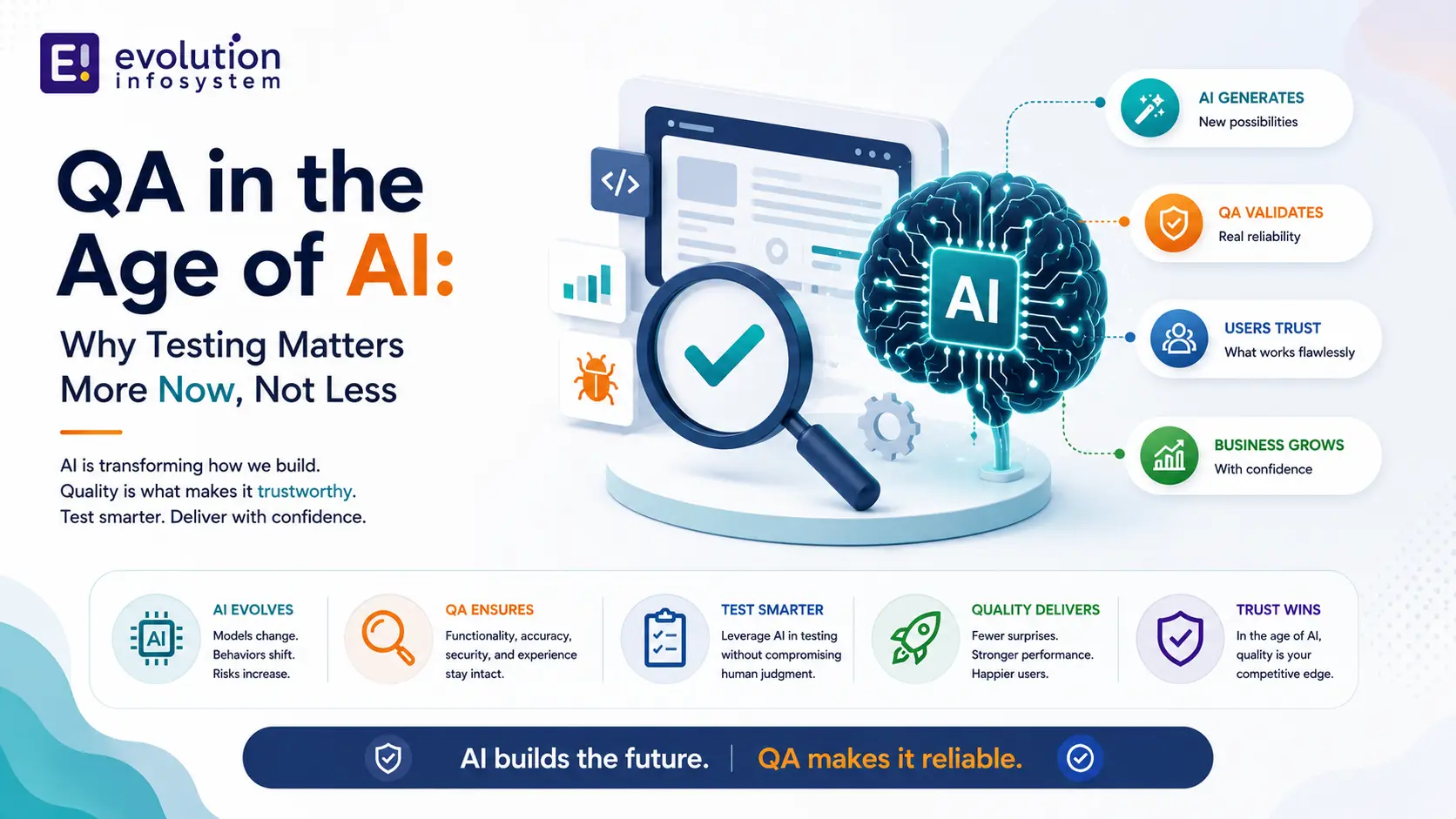
A common assumption is spreading through engineering teams right now: AI writes code faster, so we need less QA. The logic seems intuitive. If development velocity increases, the bottleneck moves elsewhere. Why invest more in testing when you can ship more?
This is wrong. Directionally, causally, consequentially wrong.
AI-assisted development raises the quality assurance bar. It doesn’t lower it. Here’s why, and what modern QA needs to look like in response.
What AI-Assisted Development Actually Changes
AI coding tools (GitHub Copilot, Cursor, Claude, and their equivalents) genuinely increase development velocity. Engineers who use them well ship more code in less time. That’s real, and it’s significant.
What also increases: the surface area of code that needs to be reviewed and tested, the confidence of the engineer in code they didn’t fully reason through, and the risk of subtle errors that look correct on inspection but fail under specific conditions.
AI-generated code has a particular failure mode that manual code doesn’t. It’s often plausible and coherent at the surface level. It compiles. It passes obvious tests. It does roughly what was asked. But it can contain logical errors, security vulnerabilities, edge case failures, and incorrect assumptions that are easy to miss in review because the code looks reasonable.
The engineer reviewing AI-generated code is often reviewing it against their mental model of what they asked for, not against a rigorous specification of what the code should actually do. This is a systematic bias toward approving code that looks right rather than code that is right.
More code, generated faster, with a review process that’s systematically biased toward approval, is not a quality improvement. It’s a quality risk. And the testing layer is the only reliable catch.
The New QA Challenges AI Creates
→ Testing AI-generated code at scale.
Development teams using AI coding tools are producing code faster than traditional QA processes were designed to handle. If your test coverage was already incomplete before AI assistance, shipping more code faster makes it worse. QA processes need to scale with development velocity, not lag behind it.
→ Testing AI features themselves.
This is categorically different from testing conventional software. Conventional software is deterministic. Given the same input, it produces the same output. You can write a test, run it, and get a binary pass/fail result.
LLM-based AI features are probabilistic. The same input can produce different outputs on different runs. Testing for correctness requires evaluating output quality, not just output existence. This demands new approaches: LLM-as-a-judge evaluation, semantic similarity scoring, human review sampling, and output classification rather than exact match testing.
→ Testing for hallucination and output drift.
AI features that work correctly at launch can degrade over time. Models update. Prompt behaviour shifts. Retrieval quality changes as data changes. An AI feature that was reliable six months ago may be unreliable today, and without continuous evaluation infrastructure, you won’t know until users tell you.
Testing AI features is not a one-time exercise at launch. It’s an ongoing operational requirement.
→ Security testing of AI-integrated systems.
AI integration introduces new attack vectors. Prompt injection, where malicious input manipulates the AI’s behaviour, is the most significant. An AI feature that accepts user input and uses it in a prompt is a potential prompt injection vulnerability. Testing for this requires adversarial testing approaches that most QA teams haven’t historically needed.
Data leakage through AI context windows is another. If your RAG pipeline retrieves sensitive documents and injects them into prompts, malicious queries designed to extract that content are a real threat. Testing for this requires deliberate red-teaming, not standard functional testing.
What Modern QA Looks Like
→ Shift left, but don’t skip.
Shift-left testing, integrating quality checks earlier in the development process rather than testing at the end, is the right philosophy for AI-assisted development. Static analysis, code review checklists, and automated unit tests should run continuously as code is written, not after a build is complete.
But shift-left doesn’t mean “skip QA.” It means QA starts earlier, not that it ends earlier. End-to-end testing, integration testing, and performance testing under realistic load still need to happen before production, regardless of how confident the AI-assisted code generation felt.
→ Automated test generation, carefully.
AI tools can generate test cases. This is genuinely useful for increasing coverage speed. It’s also a trap if used carelessly. AI-generated tests test AI-generated code against the same assumptions. Tests that miss the specification miss it in both directions.
Human-defined test strategies, covering edge cases, boundary conditions, security scenarios, and failure modes, remain essential. AI can help generate test cases within those strategies faster. It cannot replace the strategic thinking about what to test and why.
→ Eval infrastructure for AI features.
Every AI feature in production needs:
An evaluation dataset. A representative set of inputs with expected outputs or quality criteria. Minimum 50-100 examples for basic coverage. More for complex use cases.
Automated scoring. Rule-based for structured outputs (does the response contain required fields, is the classification correct). LLM-as-a-judge for generation quality (is the response helpful, accurate, appropriately scoped).
Regression testing on every change. Prompt updates, model switches, and data changes all need to run against the eval dataset before deployment. What improves one case often degrades another.
Continuous monitoring in production. Sample production outputs for quality evaluation on an ongoing basis. Catch output drift before users notice it.
→ Performance testing at realistic scale.
AI API calls have latency and rate limits. AI features under production load behave differently than in development. Load testing that includes AI API calls, with realistic concurrency and data volumes, is necessary before any AI-integrated feature goes live.
The failure modes that matter: what happens when the AI API is slow? What happens when it’s unavailable? What happens when it returns an unexpected response format? All of these need to be tested and the fallback behaviour verified.
→ Security testing specifically for AI integration.
Prompt injection testing. Attempt to manipulate the AI’s behaviour through malicious user input. This requires adversarial creativity, not just test case enumeration.
Data leakage testing. If your AI feature has access to sensitive data through RAG or tool use, test whether adversarial queries can extract that data through the AI interface.
Output validation testing. Verify that your output validation and guardrails correctly catch malicious, inappropriate, or incorrect AI outputs before they reach users.
The QA Investment That Pays Back
QA is consistently underinvested in during development and consistently blamed when things go wrong in production. The AI-assisted development wave is making both dynamics worse: faster development makes QA feel even more like a bottleneck, and more code with more AI integration means more failure modes to catch.
The businesses getting this right treat QA as a continuous function, not a pre-launch gate. They invest in automated test infrastructure that runs continuously, eval infrastructure for AI features that monitors quality over time, and security testing that specifically addresses AI integration vulnerabilities.
The cost of inadequate QA in an AI-integrated system is not a bug report from a user. It’s an AI feature that confidently produces wrong outputs, erodes user trust, and takes weeks to diagnose and fix because the failure mode wasn’t anticipated and the observability wasn’t in place to diagnose it quickly.
At Evolution Infosystem, QA is integrated into every project from the start, not bolted on at the end. For AI-integrated products, we build eval infrastructure, run adversarial security testing, and establish continuous monitoring before launch. Let’s talk about your QA requirements.
Frequently Asked Questions (FAQs)
Does AI-assisted development reduce the need for QA?
No. It increases it. AI coding tools increase development velocity and code volume while introducing a systematic review bias toward plausible-looking but potentially incorrect code. More code, generated faster, requires more rigorous testing, not less.
How do you test AI features that produce probabilistic outputs?
Through evaluation infrastructure: a dataset of representative inputs with quality criteria, automated scoring using LLM-as-a-judge or rule-based evaluation, regression testing on every change, and continuous monitoring of production output quality. Exact-match testing doesn’t work for probabilistic outputs.
What is prompt injection and why does it matter for QA?
Prompt injection is an attack where malicious user input manipulates an AI system’s behaviour. For example, a user submitting input that overrides the AI’s instructions or extracts sensitive information from its context. Testing for prompt injection requires adversarial testing approaches that specifically attempt to manipulate AI behaviour through input.
What is the most important QA investment for an AI-integrated product?
Evaluation infrastructure. Before shipping, you need a way to measure AI output quality systematically, run regression tests when anything changes, and monitor quality continuously in production. Teams that skip this discover problems from users rather than from their own testing.
How does QA for AI products differ from QA for conventional software?
Conventional software is deterministic and can be tested with exact-match assertions. AI features are probabilistic and require quality evaluation rather than exact-match testing. AI products also introduce new security vulnerabilities (prompt injection, data leakage) that require specific adversarial testing approaches.