Why Your Agency Needs an AI Development Partner, Not Just a Dev Shop
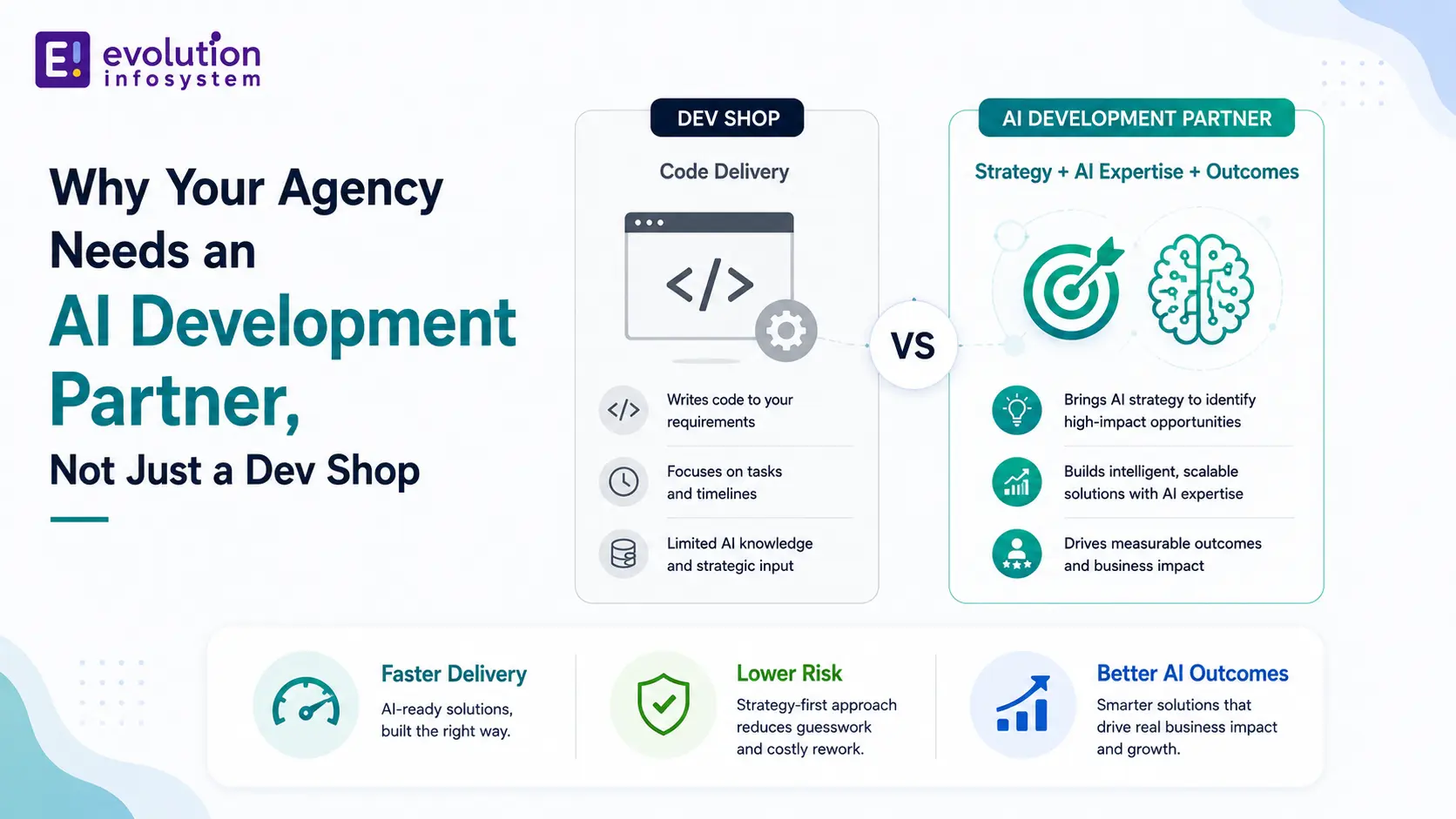
Most dev shops are not equipped for what’s happening right now.
They can build you a web app. They can maintain your codebase. They can add features to an existing product. What they cannot do is help you navigate an AI transformation, build systems that use LLMs reliably in production, or architect the kind of intelligent automation that separates competitive agencies from ones that will be commoditised in the next 18 months.
The distinction matters. And if you’re running an agency or service business trying to embed AI into your delivery, your operations, or your client products, picking the wrong kind of partner is one of the most expensive mistakes you can make right now.
What a Dev Shop Gives You
A dev shop executes. You come with a specification, they build to it, they deliver. The best ones are fast, reliable, and technically competent. The engagement model is transactional: scope in, software out.
This model works fine when you know exactly what you need to build and the technology required to build it is well understood. It breaks down when you’re working at the frontier of what’s currently possible, when requirements evolve based on what the technology reveals, and when the most important decisions aren’t “how do we build this” but “should we build this at all, and if so, what architecture gives us the best foundation.”
AI product development is almost never a clean specification hand-off. The use case is clear. The right implementation usually isn’t, not until you’ve understood your data, tested your retrieval quality, evaluated your prompt strategies, and made a series of architectural decisions that have long-term consequences.
A dev shop that hasn’t shipped production AI systems will learn on your project. That’s not a partnership. That’s you funding their education.
What the AI Wave Actually Means for Agencies Right Now
Here is what is happening in agency conversations in 2026. A client running a 40-person e-commerce operation asks their agency to add AI-powered search and personalisation to their Shopify store. The agency’s dev shop says yes, spends six weeks building something with OpenAI’s API, ships it, and three months later the client sees inconsistent results, hallucinated product descriptions, and no measurable lift in conversion. The agency loses the relationship.
A different agency partners with a team that has actually shipped production AI features. They scope the problem correctly — direct API for product description generation, RAG for search, no agent layer needed — build evaluation infrastructure before launch, and instrument quality monitoring in production. The client sees a 28% lift in search-to-purchase conversion in the first 60 days. The agency wins a two-year retained relationship.
That gap is playing out across agency client relationships globally right now. Your clients are asking for AI. Most dev shops are saying yes to things they are not equipped to deliver. The agencies paying the price are the ones that recommended the wrong partners.
The bottleneck is not ambition. It is the capability to execute at the speed and quality the market now demands. An AI development partner closes that gap. A generic dev shop widens it.
The Five Differences That Actually Matter
1. They start with the problem, not the tool.
A generic dev shop will ask you what you want to build. An AI development partner asks what problem you’re trying to solve, whether AI is actually the right solution, and if so, which approach gives you the best risk-to-value ratio for your specific situation.
This sounds obvious. In practice, the majority of AI feature requests can be solved more simply, more reliably, and faster than the requestor imagined, or they reveal a process problem that AI won’t fix. A partner who surfaces this saves you significant time. A shop that takes the brief and executes doesn’t.
2. They have production AI experience, not just AI familiarity.
There is a significant difference between a team that has experimented with AI tools and a team that has shipped AI features used by real users at production scale. The hard problems in AI product development, retrieval quality, output consistency, prompt regression, latency under load, graceful degradation when APIs fail, don’t show up in demos. They show up at 3am when something breaks in production.
Ask any potential partner: what AI features have you shipped to production? What broke and how did you fix it? Teams with real production experience have specific, detailed answers. Teams without it give you vague confidence.
3. They own the architecture decision, not just the implementation.
The most consequential decisions in AI product development are architectural. Direct API call or RAG pipeline. Single agent or multi-agent. Which vector database. How to handle context window limits. When to cache and when not to. These decisions have compounding consequences; they’re easy to get wrong and hard to undo.
A dev shop implements what you specify. An AI development partner tells you what you should specify and why, pushes back when the architecture you’ve imagined isn’t the right one, and takes responsibility for the quality of those decisions alongside you.
4. They build for reliability, not just capability.
An AI feature that works in a demo and degrades in production is worse than no AI feature. It erodes user trust in a way that’s hard to recover from.
Reliability in AI product development means evaluation infrastructure before shipping, prompt versioning and regression testing, output validation and guardrails, observability at every layer, and graceful fallbacks when models behave unexpectedly. Most dev shops skip these because they add time, and they’re invisible in a demo. An AI development partner doesn’t skip them because they’ve seen what happens when you do.
5. They stay current in a field that moves weekly.
The AI landscape changes faster than any other area of software development. Models improve. New APIs release. Better frameworks emerge. Best practices evolve. A team that built excellent RAG systems six months ago needs to stay current to build excellent RAG systems today.
A generic dev shop dips into AI when a client asks for it. An AI development partner is operating in this space every day. The difference in current knowledge is significant, and it shows in the quality of the architectural decisions they make.
What to Look for in an AI Development Partner
→ Specific production examples.
Not “we’ve worked with AI” but “we built this RAG pipeline for this client, here’s the retrieval approach we used, here’s the eval infrastructure, here’s what we learned.” Specificity is the signal.
→ Opinions.
A good AI development partner has strong views about when to use RAG vs fine-tuning, which LLMs suit which use cases, how to handle output validation. They should be willing to tell you when your idea is overengineered, when a simpler approach would work better, and when AI is not actually the right solution. Consultative partners disagree with you sometimes. Execution shops don’t.
→ Process for evaluation and reliability.
Ask directly: how do you test AI output quality before shipping? How do you handle prompt updates without breaking existing behaviour? A team without clear answers here hasn’t operated production AI systems seriously.
→ Transparency about limitations.
An AI development partner should be honest about what current models can and can’t do reliably, where hallucination risk is real, and what human oversight is needed. Overpromising on AI capability is a red flag, not a green one.
The Cost of Getting This Wrong
Choosing a generic dev shop for an AI project that needs a real partner costs you in three ways.
→ Time.
You spend weeks or months on an approach that an experienced team would have steered you away from in the first meeting.
→ Quality.
The AI features you ship are brittle, inconsistent, or unreliable. Users notice. Trust erodes.
→ Opportunity.
While you’re rebuilding what didn’t work, your competitors are shipping. In a market moving as fast as this one, six months of lost time is significant.
The AI wave is not slowing down. The window for agencies to build AI-native capabilities into their delivery is now, not when the market stabilises. Getting the right partner in place is the first real decision.
At Evolution Infosystem, we work with agencies and service businesses that need to move fast on AI without sacrificing quality or reliability. We’re not a dev shop that occasionally does AI projects. AI-driven development is what we do. Let’s talk about what you’re building.
Frequently Asked Questions (FAQs)
What is the difference between an AI development partner and a dev shop?
A dev shop executes your specification. An AI development partner helps define the right specification, owns the architectural decisions, brings production AI experience, and stays accountable to the reliability and quality of what gets built, not just the delivery of code.
How do I know if a development company genuinely has AI expertise?
Ask for specific production examples, not case studies. Ask what broke and how they fixed it. Ask about their evaluation and testing process for AI outputs. Ask what they would have done differently. Teams with real experience have specific, detailed answers. Teams without it don’t.
Why can’t a generic software development company handle AI projects?
They can handle simple AI API integrations. Where they fall short is in the architectural decisions that determine long-term reliability, the evaluation infrastructure needed to ship with confidence, and the current knowledge required to make good decisions in a field that changes weekly.
When should an agency build an in-house AI team vs. using an external partner?
Use an external partner when you need to move fast, when AI is not your core product, or when hiring a capable in-house AI team would take longer than your competitive window allows. Build in-house when AI is your primary product differentiator, and you need full control over your model development roadmap.